
publié par
Fanie Précourt
19 août 2026
This project is part of ‘Indian Ocean Historical Sound Archive: collecting, safeguarding and sharing musical heritage’. It is co-financed by the Interreg VI Indian Ocean 2021-2027 programme, the French Embassy in the Seychelles, the Regional Council of Reunion, the Directorate of Cultural Affairs, and the Departmental Council of Reunion. It follows on from organological studies conducted in Mayotte in 2022 and Reunion in 2023. Building on this work, the PHOI team carried out a collection mission in the Seychelles during October and November 2025.
These accounts, gathered mainly from musicians and instrument makers, aim to celebrate Seychellois musical practices as well as raise awareness of them, ensuring their transmission and longevity for future generations. They offer the general public a chance to rediscover — or indeed discover — traditions, both past and present, as well as the instruments that enrich the region’s varied and diverse identity.
In these podcast episodes, the musicians also share insights into their professional journeys and the day-to-day realities of their work. They provide an overview of cultural life across the Seychelles, touching on ongoing dynamics as well as the difficulties and challenges they face. These testimonies thus shed valuable light on the current state of the music sector in the Seychelles.
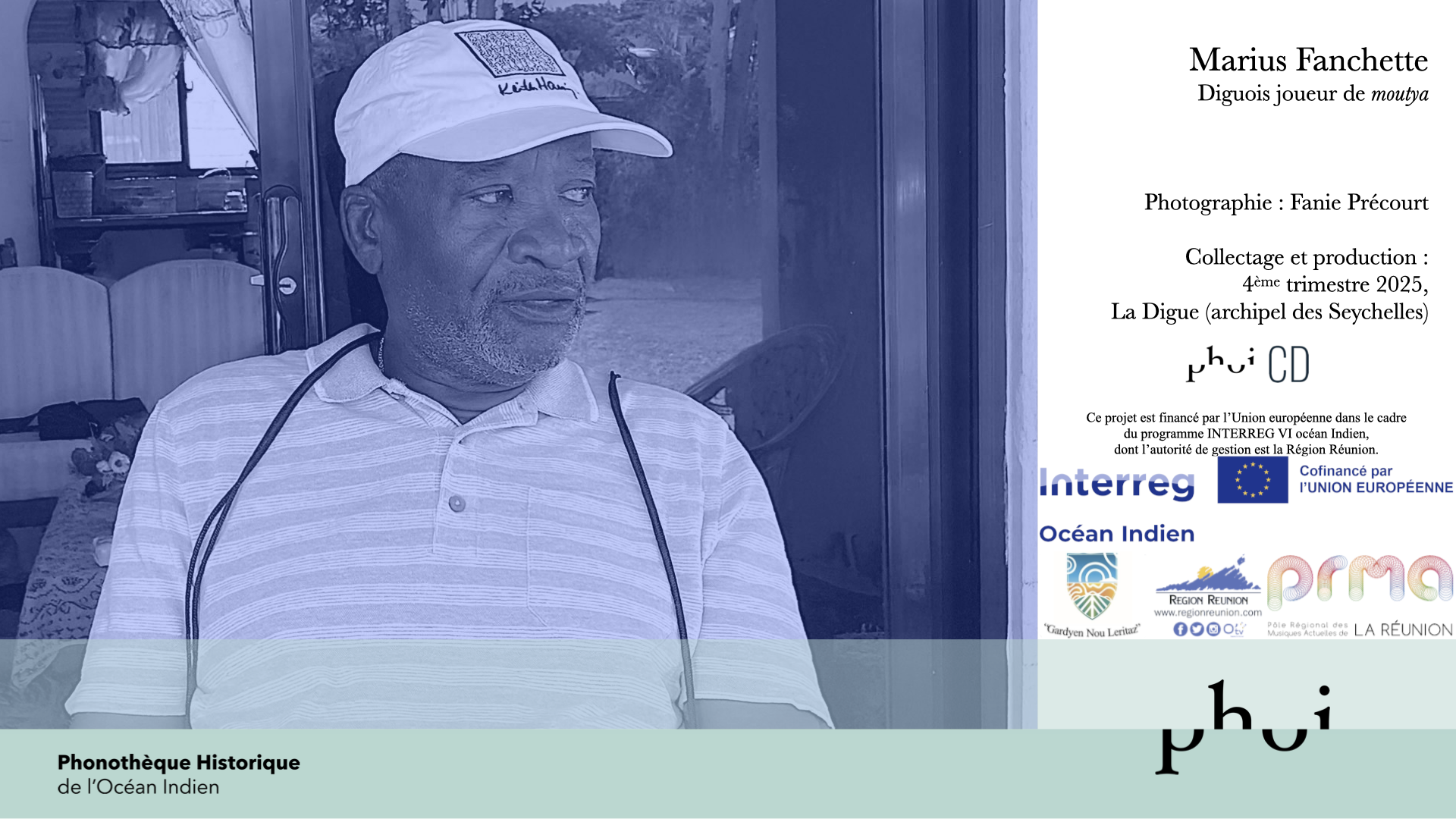
 Ethnographie des musiciens - Interview de Marius Fanchette - La Digue, 11/25.
 In this episode, Marius Fanchette, born on La Digue in 1967, shares his deep commitment to the traditional music of the Seychelles. A member of the group ‘Masézarine’ since 1982, he advocates a way of doing things that is rooted in transmission and free of government influence. The son of a tanbour moutya drummer, Marius learnt by watching his father from a very early age. He now plays the tanbour moutya, tanbour sega, and triyang, as well as the full range of percussion instruments used in the archipelago's musical traditions. He describes the structure of moutya: the music begins with the call of the ‘signal’, a metal receptacle mounted on a stand and struck with two wooden sticks (similar to the pikèr in Reunion). Next come the accompanying drums, followed by the bass drum, which lays down the rhythmic foundation through its ‘pounding’ beat. The signal drives the music, almost like a lead guitar: as soon as it joins in, the rhythm is firmly established. Within Masézarine, the younger generation have since taken over on the drums, but Marius would like to see more of them get involved in order to ensure the continued survival of this cultural heritage. He regrets that international music occupies too prominent a place in the Seychelles, and criticises radio stations for not doing enough to broadcast local repertoires. In his view, preserving traditional music also means learning Seychellois dances. In the past, especially in the highlands of La Digue, people danced regularly, with every district having its own group that would showcase its expertise at festivals. With the passing of the older generations, this tradition has weakened and some of its values have been lost. Nevertheless, the cha-cha-cha, masezarine, madilo and indeed the moutya should continue to inspire and unite the Seychellois around their shared cultural identity.
Fanie Précourt
