
This project is part of ‘Indian Ocean Historical Sound Archive: collecting, safeguarding and sharing musical heritage’. It is co-financed by the Interreg VI Indian Ocean 2021-2027 programme, the French Embassy in the Seychelles, the Regional Council of Reunion, the Directorate of Cultural Affairs, and the Departmental Council of Reunion. It follows on from organological studies conducted in Mayotte in 2022 and Reunion in 2023. Building on this work, the PHOI team carried out a collection mission in the Seychelles during October and November 2025.
publié par
Fanie Précourt
14 août 2026
These accounts, gathered mainly from musicians and instrument makers, aim to celebrate Seychellois musical practices as well as raise awareness of them, ensuring their transmission and longevity for future generations. They offer the general public a chance to rediscover — or indeed discover — traditions, both past and present, as well as the instruments that enrich the region’s varied and diverse identity.
In these podcast episodes, the musicians also share insights into their professional journeys and the day-to-day realities of their work. They provide an overview of cultural life across the Seychelles, touching on ongoing dynamics as well as the difficulties and challenges they face. These testimonies thus shed valuable light on the current state of the music sector in the Seychelles.
 Ethnographie des musiciens - Interview de Nac Joely - Mahé, 11/25.
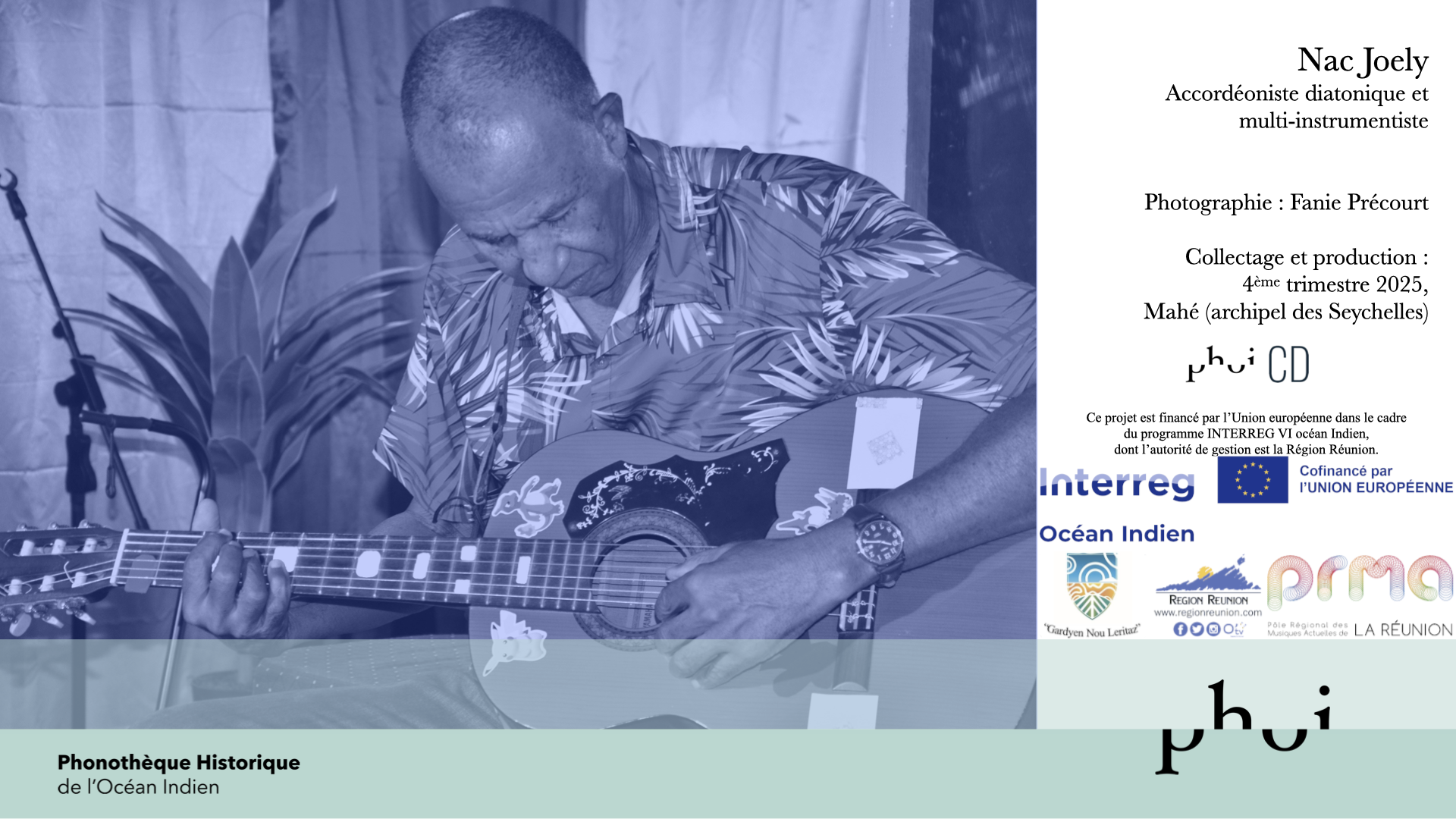
 In this episode, Nac Joely, – who performs under the stage name Étienne – talks enthusiastically about his favourite instrument: the diatonic accordion, which was once known as the ‘piston accordion’. It was so called because of the four buttons at the top, which alter the sound. He describes its technical characteristics as well as its limitations: it is expensive both to purchase and to repair. The tone of the diatonic accordion differs from that of its chromatic counterpart and has more in common with the harmonica. Playing it is also more complex, as separate notes are produced depending on whether the bellows are being pushed or pulled. After many years of touring, Nac realised that his playing style was distinct from that of his fellow accordionists. In addition, he tells the story of how, some years ago, he received a diatonic accordion in return for a favour, but it was not in working order because six reeds had broken after years of disuse. The instrument he plays today was a gift from David André when they were on tour in Dubai. However, two or three notes are out of tune, and such repairs are especially difficult to get done in the Seychelles. Nac reveals that there is only one other elderly diatonic accordion player left on the islands: Mr Lary, who is no longer active. The repertoire Nac performs most often is kanmtole, as his work involves promoting Seychellois music around the world, taking him to France, Portugal, India, Reunion Island, South Africa, South Korea, and even Japan. Despite his impressive career, he regrets that there is currently no one to succeed him: his son – who also played the instrument – has passed away, and young people seem to have little interest in continuing the local tradition.
Fanie Précourt
