
published by
Fanie Précourt
22 septembre 2026
This project is part of ‘Indian Ocean Historical Sound Archive: collecting, safeguarding and sharing musical heritage’. It is co-financed by the Interreg VI Indian Ocean 2021-2027 programme, the French Embassy in the Seychelles, the Regional Council of Reunion, the Directorate of Cultural Affairs, and the Departmental Council of Reunion. It follows on from organological studies conducted in Mayotte in 2022 and Reunion in 2023. Building on this work, the PHOI team carried out a collection mission in the Seychelles during October and November 2025.
These accounts, gathered mainly from musicians and instrument makers, aim to celebrate Seychellois musical practices as well as raise awareness of them, ensuring their transmission and longevity for future generations. They offer the general public a chance to rediscover — or indeed discover — traditions, both past and present, as well as the instruments that enrich the region’s varied and diverse identity.
In these podcast episodes, the musicians also share insights into their professional journeys and the day-to-day realities of their work. They provide an overview of cultural life across the Seychelles, touching on ongoing dynamics as well as the difficulties and challenges they face. These testimonies thus shed valuable light on the current state of the music sector in the Seychelles.
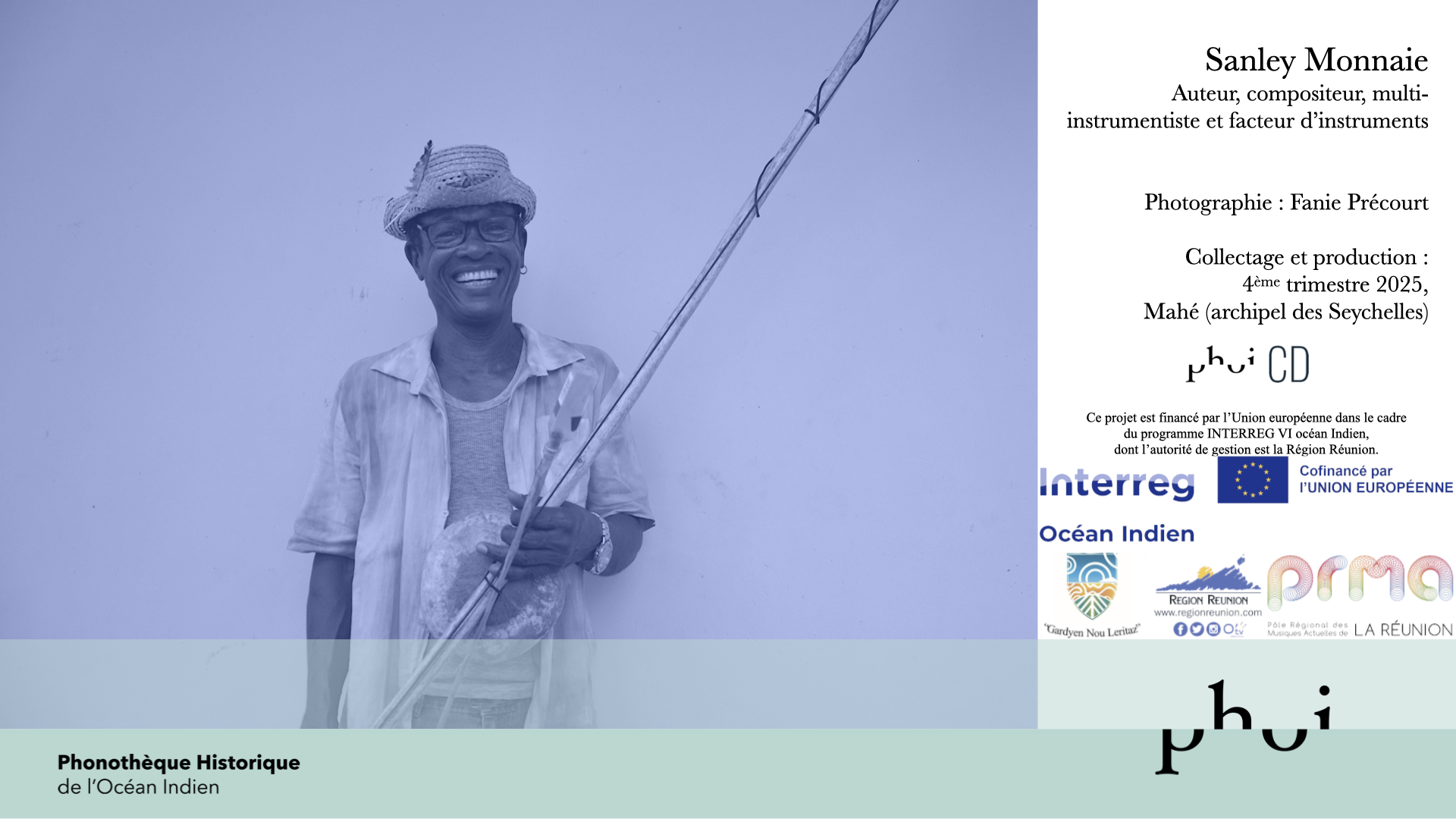
 Ethnographie des musiciens - Interview de Sanley Monnaie - Mahé, 11/26.
 In this episode, Sanley Monnaie, born in La Digue in 1963, reminisces about his childhood steeped in music. He grew up around musicians, especially bonm players, and from his earliest years his violinist father instilled a taste for traditional sounds in him. Immersed in this artistic melting pot, he started playing from a very young age and joined his first group as a backing guitarist when he was only thirteen. Encouraged by Patrick Victor, he gradually expanded the range of instruments he could play, and learnt the banjo. Both curious and enthusiastic, he has mastered the bonm too — singing as he plays — the tanbour moutya, the makalapo and even the valiha, a traditional tube zither from Madagascar. As a result, he has become proficient in most of the instruments synonymous with the region's musical heritage. Deeply attached to traditional repertoires, he also appreciates the creative scope offered by the electric guitar, identifying above all as a guitarist. Keen to protect a legacy that is rapidly vanishing, he works hard to promote endangered instruments – to the extent of making some himself. Sanley firmly believes that traditional music remains essential and must be preserved. Advocating an open and inclusive outlook, he maintains that everyone is free to make their own musical choices, but that it is essential to safeguard and pass on these cultural expressions, which lie at the heart of Creole and Seychellois identity.
Fanie Précourt
