
This project is part of ‘Indian Ocean Historical Sound Archive: collecting, safeguarding and sharing musical heritage’. It is co-financed by the Interreg VI Indian Ocean 2021-2027 programme, the French Embassy in the Seychelles, the Regional Council of Reunion, the Directorate of Cultural Affairs, and the Departmental Council of Reunion. It follows on from organological studies conducted in Mayotte in 2022 and Reunion in 2023. Building on this work, the PHOI team carried out a collection mission in the Seychelles during October and November 2025.
published by
Fanie Précourt
15 octobre 2026
These accounts, gathered mainly from musicians and instrument makers, aim to celebrate Seychellois musical practices as well as raise awareness of them, ensuring their transmission and longevity for future generations. They offer the general public a chance to rediscover — or indeed discover — traditions, both past and present, as well as the instruments that enrich the region’s varied and diverse identity.
À In these podcast episodes, the musicians also share insights into their professional journeys and the day-to-day realities of their work. They provide an overview of cultural life across the Seychelles, touching on ongoing dynamics as well as the difficulties and challenges they face. These testimonies thus shed valuable light on the current state of the music sector in the Seychelles.
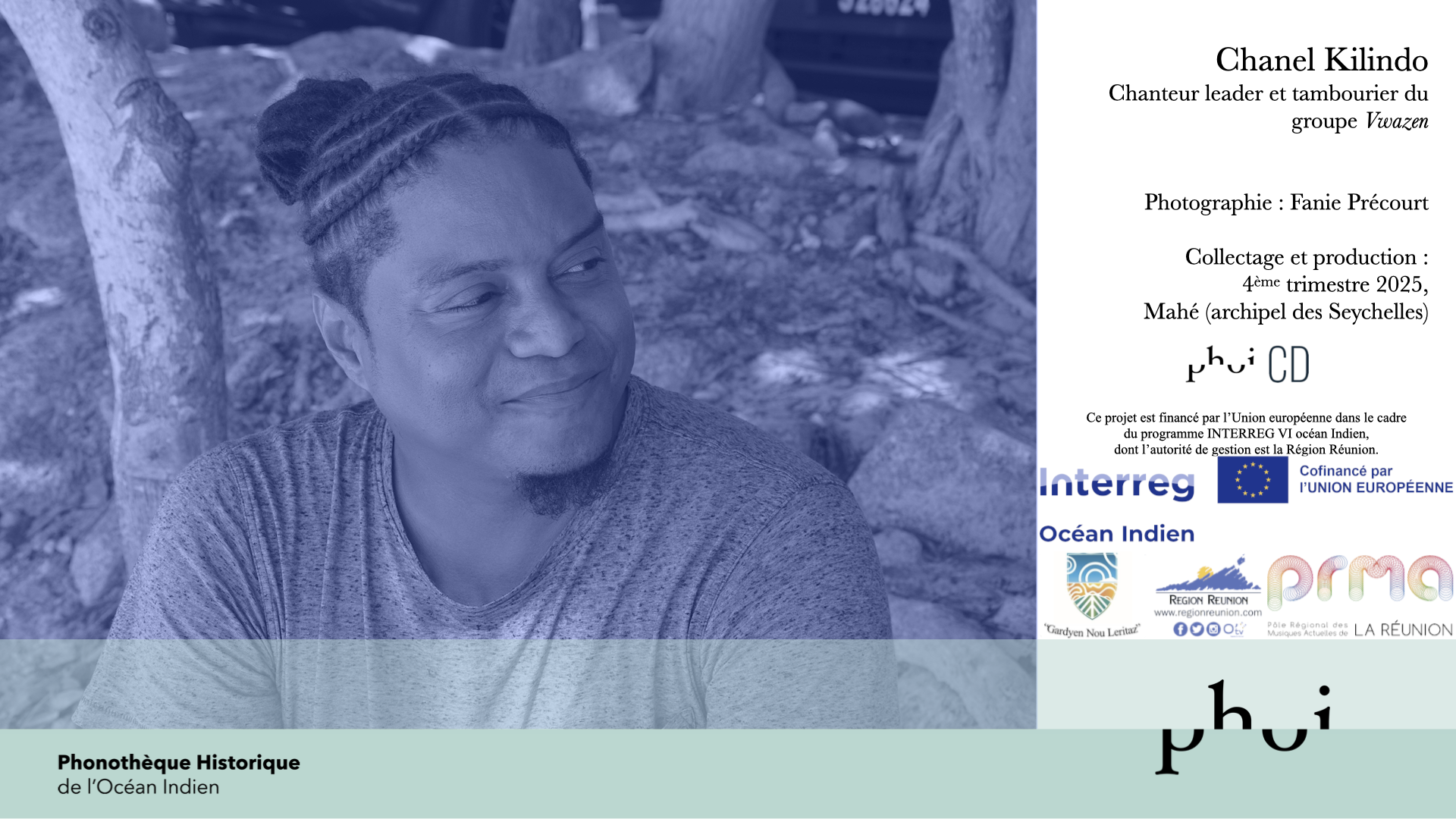
 Ethnographie des musiciens - Interview de Chanel Kilindo - Mahé - 11/25.
 In this episode, Chanel Kilindo (born 1986), a singer, tanbour moutya player, and leader of the group ‘Vwazin’, begins by looking back at how he developed his love for moutya. Introduced to the genre at a very young age by his uncle Marc Dubel, he watched local bands perform this repertoire until he could no longer resist the urge to play the tanbour moutya himself. He goes on to explain the standard instrumental line-up of moutya, consisting of three drums that vary in size, pitch and timbre. The largest of these, a 22-inch drum, provides the bass. The tanbour player uses a technique called pil by emphasising the pulse. The medium-sized 20-inch drum is used for vané, meaning it lays down the basic beats. The third drum, which is smaller and higher-pitched, serves to create flourishes known as denotan. Chanel also points out that moutya is just one facet of Seychellois musical heritage; others include the sokwe and tsinge, both of which are much less commonly practised today and are therefore even more endangered. Lastly, he expresses his desire to dedicate himself to music full-time and to help traditional repertoires thrive – a goal requiring commitment, passion, energy and a genuine philosophy of life in all that he does.
Fanie Précourt
