
publié par
Fanie Précourt
3 novembre 2026
This project is part of ‘Indian Ocean Historical Sound Archive: collecting, safeguarding and sharing musical heritage’. It is co-financed by the Interreg VI Indian Ocean 2021-2027 programme, the French Embassy in the Seychelles, the Regional Council of Reunion, the Directorate of Cultural Affairs, and the Departmental Council of Reunion. It follows on from organological studies conducted in Mayotte in 2022 and Reunion in 2023. Building on this work, the PHOI team carried out a collection mission in the Seychelles during October and November 2025.
These accounts, gathered mainly from musicians and instrument makers, aim to celebrate Seychellois musical practices as well as raise awareness of them, ensuring their transmission and longevity for future generations. They offer the general public a chance to rediscover — or indeed discover — traditions, both past and present, as well as the instruments that enrich the region’s varied and diverse identity.
In these podcast episodes, the musicians also share insights into their professional journeys and the day-to-day realities of their work. They provide an overview of cultural life across the Seychelles, touching on ongoing dynamics as well as the difficulties and challenges they face. These testimonies thus shed valuable light on the current state of the music sector in the Seychelles.
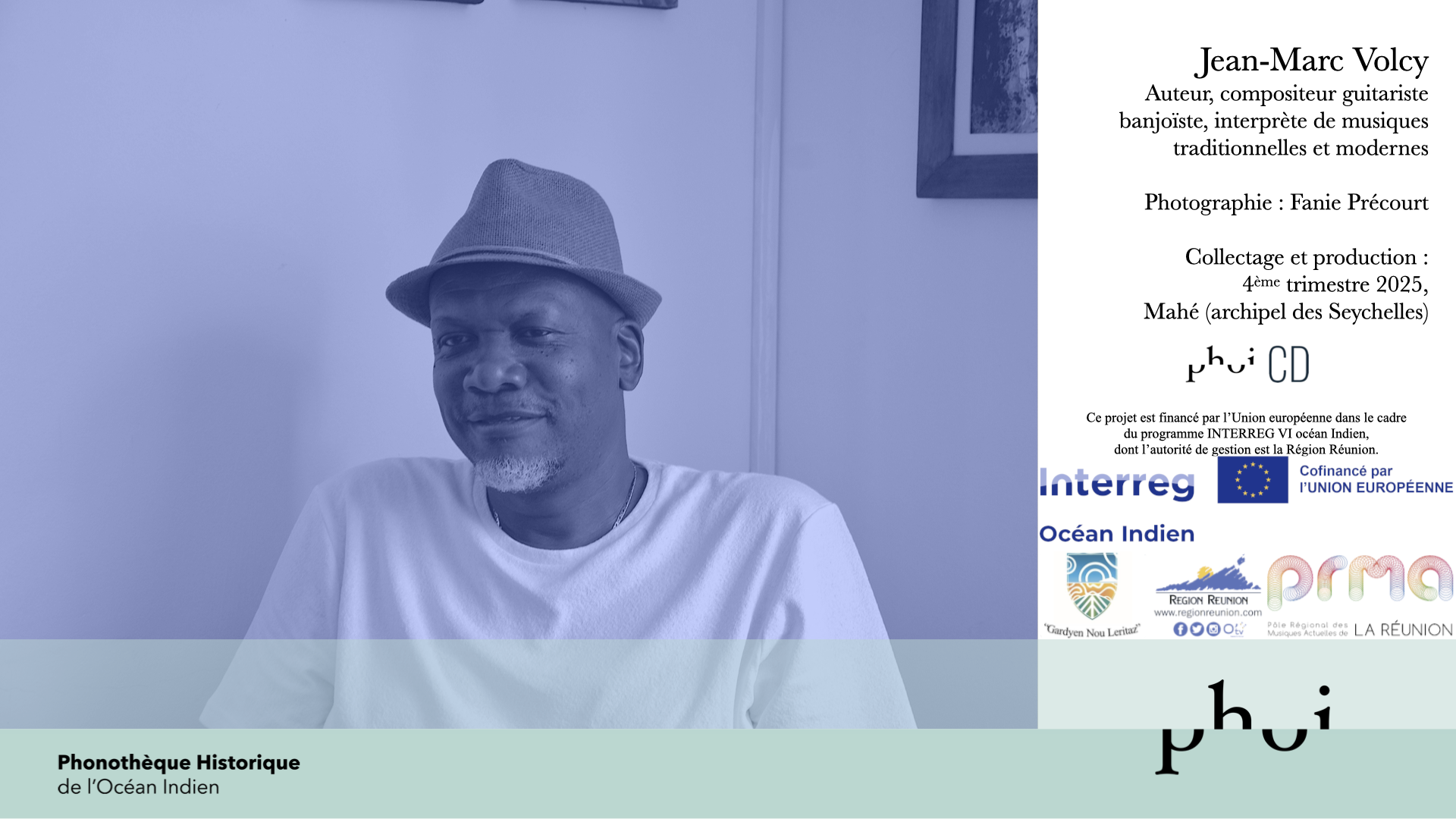
 Ethnographie des musiciens - Interview de Jean-Marc Volcy - Mahé - 10/25
 In this episode, Jean-Marc Volcy, born in 1966, describes how he chose a career in music as a means of promoting Seychellois traditions – such as sega, moutya and kanmtole – beyond the archipelago. His passion for music was sparked in 1982, when he learnt the basics of guitar from his uncle, an amateur musician. He went on to hone his skills by playing regularly with friends. At the same time, former primary school teacher Thomas Alexis introduced him to the benndyo. Volcy also took up the tanbour moutya drum, although he does not consider himself a master tanbouriye. As a singer-songwriter and performer, Jean-Marc Volcy writes lyrics rooted in Seychellois life, carrying positive, moral, and spiritual messages. He composes love songs for other musicians, too. He rose to fame in 1993 with the track ‘Vandredi Sen’, which first brought him to the attention of a wider audience. While working at the Ministry of Culture, he joined Latroup Nasyonal Sesel, before founding the group ‘Boya’ with Melvin Camille on drums and Brian Matombé on violin. He goes on to mention the bal bobès, an event for sharing and passing on traditional Seychellois heritage, which in his view is a symbol of national unity. This large-scale celebration of Creole identity – now held annually as part of the Festival Kreol – proves popular with young people too. He laments, however, that the upcoming generation remains strongly influenced by international sounds, at the expense of local culture. He fears that this tendency is slowly eroding traditional music and Seychellois identity, neither of which is currently acknowledged as a priority.
Fanie Précourt
