
published by
Fanie Précourt
30 octobre 2026
This project is part of ‘Indian Ocean Historical Sound Archive: collecting, safeguarding and sharing musical heritage’. It is co-financed by the Interreg VI Indian Ocean 2021-2027 programme, the French Embassy in the Seychelles, the Regional Council of Reunion, the Directorate of Cultural Affairs, and the Departmental Council of Reunion. It follows on from organological studies conducted in Mayotte in 2022 and Reunion in 2023. Building on this work, the PHOI team carried out a collection mission in the Seychelles during October and November 2025.
These accounts, gathered mainly from musicians and instrument makers, aim to celebrate Seychellois musical practices as well as raise awareness of them, ensuring their transmission and longevity for future generations. They offer the general public a chance to rediscover — or indeed discover — traditions, both past and present, as well as the instruments that enrich the region’s varied and diverse identity.
In these podcast episodes, the musicians also share insights into their professional journeys and the day-to-day realities of their work. They provide an overview of cultural life across the Seychelles, touching on ongoing dynamics as well as the difficulties and challenges they face. These testimonies thus shed valuable light on the current state of the music sector in the Seychelles.
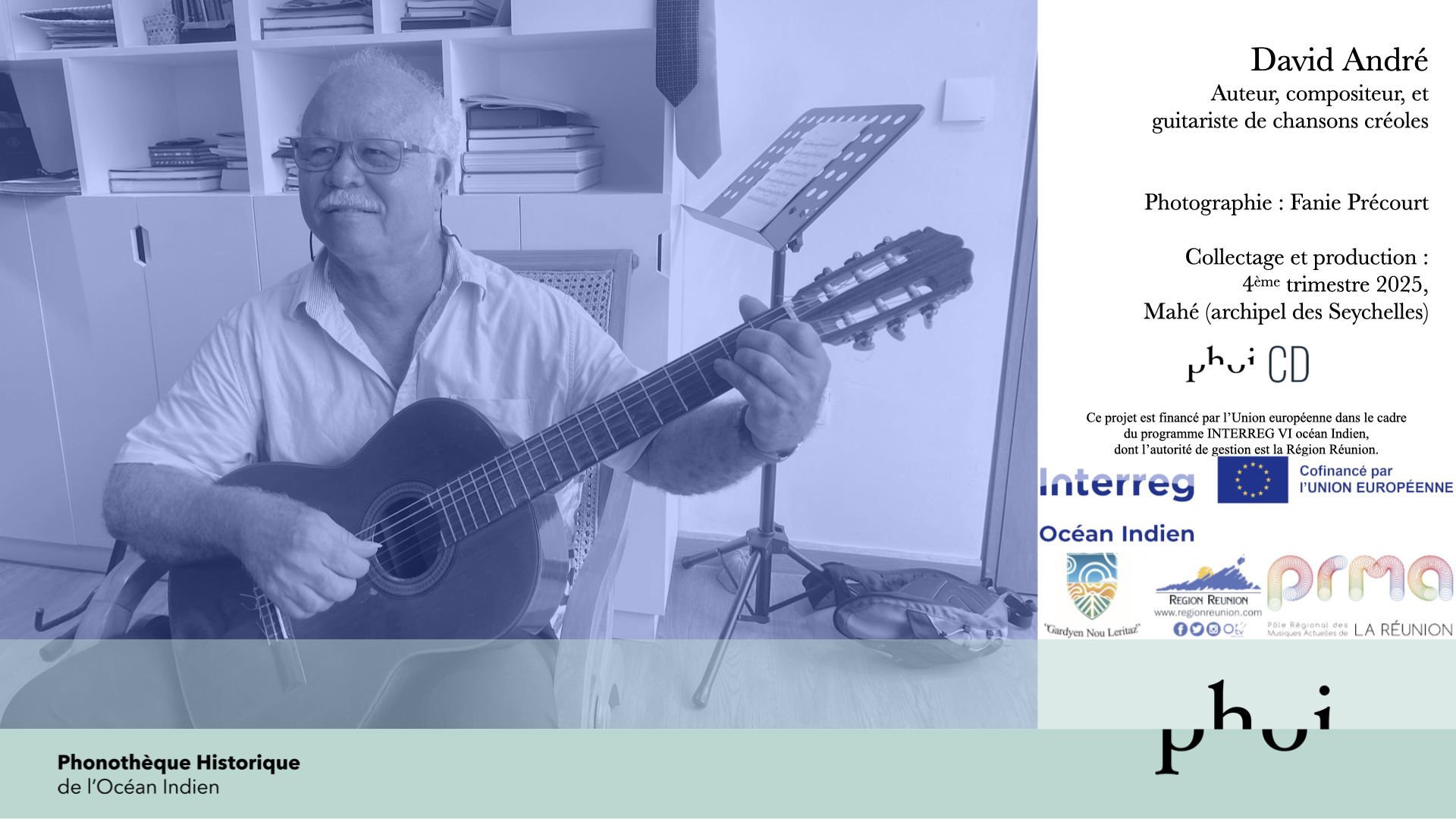
 Ethnographie des musiciens - Interview de David André - Mahé - 11/25
 In this episode, musician David André (born 1958) shares his perspective as Secretary-General of the Seychelles National Institute for Culture, Heritage and the Arts, an establishment that succeeded the Ministry of Culture. In his view, traditional Seychellois music remains very much alive. This is powerfully expressed during the annual Festival Kreol, which brings together people of all ages for a wide variety of cultural events. Despite the broad reach of the English-speaking world, he highlights that the entire population actively participates in local musical practices. Author of the Seychelles national anthem, he has a strong attachment to Creole song and ballads, while also, albeit to a lesser extent, embracing the tradition of sega. He sees music as a key component of Seychellois Creole identity, shaped by a diverse heritage blending African, European and Asian influences.
Fanie Précourt
