
publié par
Fanie Précourt
6 octobre 2026
This project is part of ‘Indian Ocean Historical Sound Archive: collecting, safeguarding and sharing musical heritage’. It is co-financed by the Interreg VI Indian Ocean 2021-2027 programme, the French Embassy in the Seychelles, the Regional Council of Reunion, the Directorate of Cultural Affairs, and the Departmental Council of Reunion. It follows on from organological studies conducted in Mayotte in 2022 and Reunion in 2023. Building on this work, the PHOI team carried out a collection mission in the Seychelles during October and November 2025.
These accounts, gathered mainly from musicians and instrument makers, aim to celebrate Seychellois musical practices as well as raise awareness of them, ensuring their transmission and longevity for future generations. They offer the general public a chance to rediscover — or indeed discover — traditions, both past and present, as well as the instruments that enrich the region’s varied and diverse identity.
In these podcast episodes, the musicians also share insights into their professional journeys and the day-to-day realities of their work. They provide an overview of cultural life across the Seychelles, touching on ongoing dynamics as well as the difficulties and challenges they face. These testimonies thus shed valuable light on the current state of the music sector in the Seychelles.
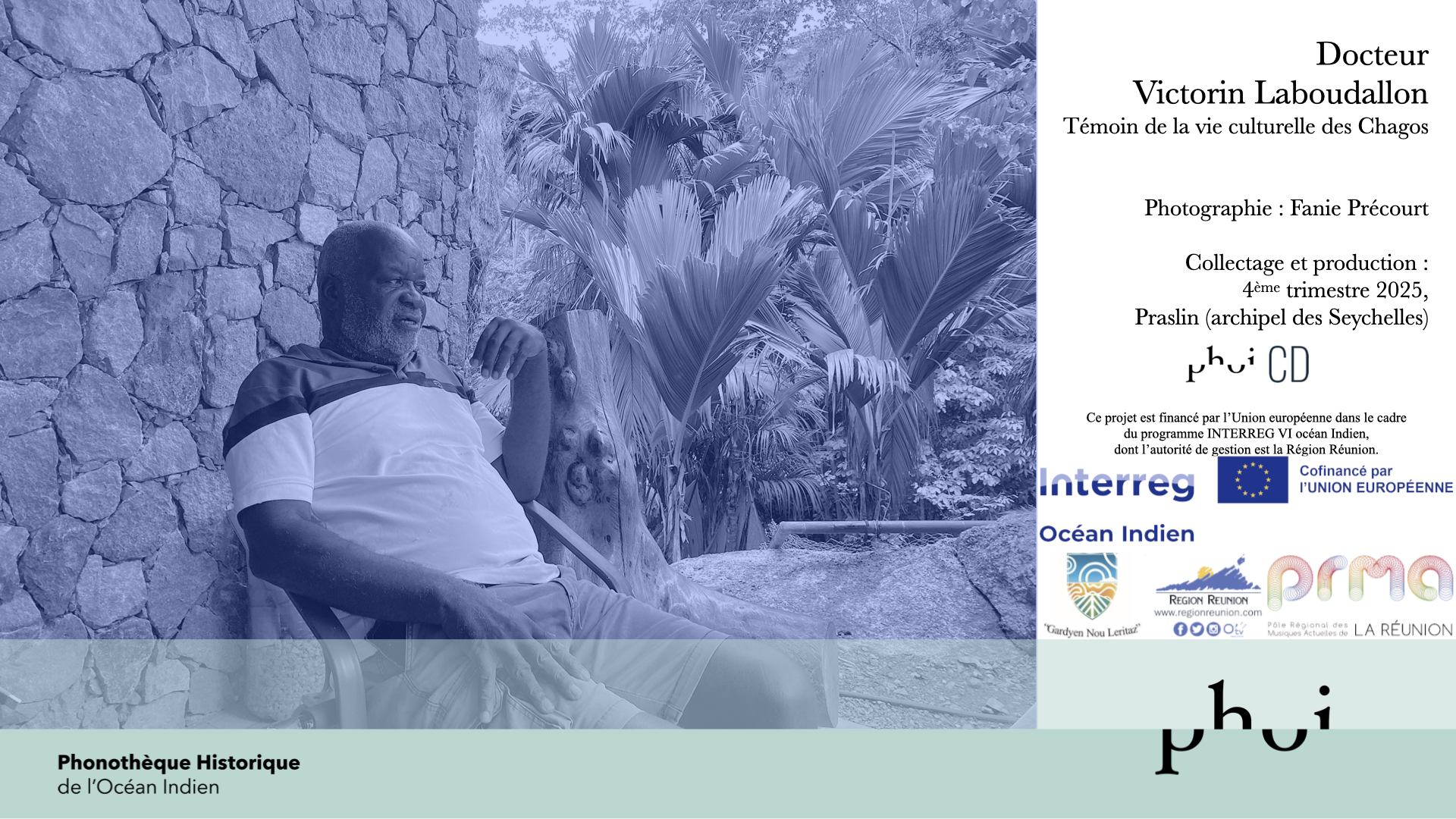
 Ethnographie des musiciens - Interview de Victorin Laboudallon - Praslin, 11/25.
 In this episode, Victorin Laboudallon, born on Mahé in 1954, shares his memories of festivities on Diego Garcia, an island in the Chagos Archipelago whose inhabitants were forcibly exiled in 1971. He had the opportunity to go there twice, once in 1967 and then again in 1980. A keen musician, he wrote several songs there before being expelled by the Americans and forced to return to the Seychelles. His best-known track, Edna, was recorded on cassette, and his band consisted of tanbour drummers, while he played the guitar. Side by side, they performed many a sega to dancers’ delight. The tanbours were fashioned from the skins of goats and donkeys. Oil drums – such as those meant for transporting petrol to light fires – were also used to accompany certain segas. At festive gatherings a space was always set aside for lighting a fire to heat the instruments. Dancing would often begin with a sega larond, where the men took up position at the front of a circle, while the women followed behind, bringing together the whole community. Two groups would depart from opposite sides of the island (one from the east, the other from the west), converging in the middle and thus heralding the start of the sega. For its part, the moutya could be sabotaged using casuarina or takamaka seeds, or small coconuts. Anyone caught with these items in their pockets risked being ejected. This was because they would burst and damage the tanbour skin if tossed into the flames. One particular word, 'aylanbo', was used to instantly halt tanbour drumming mid-moutya. This alerted everyone that an accident had just occurred, such as a fire or a boat capsizing. Back then, offenders could be fined for performing moutya in Victoria, on the island of Mahé, as it was outlawed there, so this genre of music was mainly practised on the outer islands. Clergy would sometimes go so far as to smash the tanbours used during Saturday night gatherings, thus playing a key role in having this tradition banned.
Fanie Précourt
