
published by
Fanie Précourt
2 octobre 2026
This project is part of ‘Indian Ocean Historical Sound Archive: collecting, safeguarding and sharing musical heritage’. It is co-financed by the Interreg VI Indian Ocean 2021-2027 programme, the French Embassy in the Seychelles, the Regional Council of Reunion, the Directorate of Cultural Affairs, and the Departmental Council of Reunion. It follows on from organological studies conducted in Mayotte in 2022 and Reunion in 2023. Building on this work, the PHOI team carried out a collection mission in the Seychelles during October and November 2025.
These accounts, gathered mainly from musicians and instrument makers, aim to celebrate Seychellois musical practices as well as raise awareness of them, ensuring their transmission and longevity for future generations. They offer the general public a chance to rediscover — or indeed discover — traditions, both past and present, as well as the instruments that enrich the region’s varied and diverse identity.
In these podcast episodes, the musicians also share insights into their professional journeys and the day-to-day realities of their work. They provide an overview of cultural life across the Seychelles, touching on ongoing dynamics as well as the difficulties and challenges they face. These testimonies thus shed valuable light on the current state of the music sector in the Seychelles.
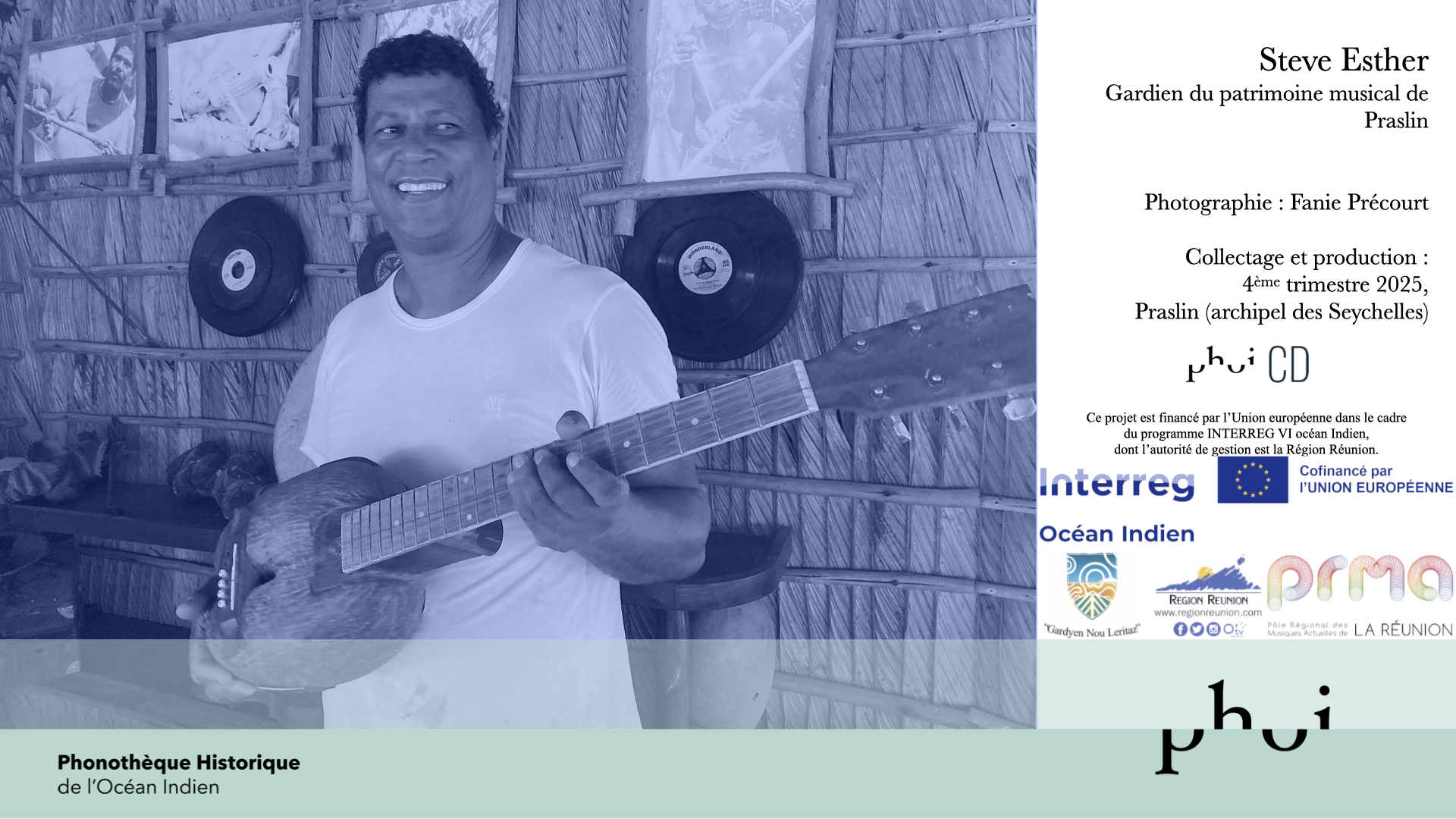
 Ethnographie des musiciens - Interview de Steve Esther - Praslin, 11/25.
 In this episode, Steve Ester, born in 1970 in Praslin, talks about his love of Seychellois traditions, which led him to found a museum dedicated to cultural heritage. An accomplished musician himself, he places great value on preserving and showcasing instruments that are under threat of disappearing, such as the zez, tanbour moutya and bonm. Every day, he plays them for visitors to his museum, who are keen to hear what they sound like. He notes that traditional musicians becoming increasingly rare on Praslin. The older generation has faded away, and the next generation is struggling to fill their shoes. Steve is an instrument maker in his own right, perpetuating traditional craftsmanship by using local wood such as bwa zozo and bwa var, which are prized for their flexibility. Nevertheless, certain raw materials, especially calabashes, are becoming increasingly hard to come by. As for strings, he prefers nylon or metal as they produce a better sound. In addition, Steve points out that there are few individuals left who still make traditional instruments, and that although younger people do visit the museum, they are more attracted to modern music. However, he notes that the bonm, despite its apparent simplicity, is a challenging instrument that requires both precision and proficiency. He draws inspiration from elders – such as Ton Pa, who added jingles to his bonm stick – while also innovating. For instance, Steve uses coconuts, which are plentiful on Praslin, to develop traditional instrument making. Designed with portability in mind, his makalapo differs from the traditional model that historically has been linked to the spirit world and the earth’s innermost forces. With these adaptations Steve aims to strike a balance between reverence for tradition and creativity, helping to keep a fragile cultural heritage alive.
Fanie Précourt
