
published by
Fanie Précourt
18 septembre 2026
This project is part of ‘Indian Ocean Historical Sound Archive: collecting, safeguarding and sharing musical heritage’. It is co-financed by the Interreg VI Indian Ocean 2021-2027 programme, the French Embassy in the Seychelles, the Regional Council of Reunion, the Directorate of Cultural Affairs, and the Departmental Council of Reunion. It follows on from organological studies conducted in Mayotte in 2022 and Reunion in 2023. Building on this work, the PHOI team carried out a collection mission in the Seychelles during October and November 2025.
These accounts, gathered mainly from musicians and instrument makers, aim to celebrate Seychellois musical practices as well as raise awareness of them, ensuring their transmission and longevity for future generations. They offer the general public a chance to rediscover — or indeed discover — traditions, both past and present, as well as the instruments that enrich the region’s varied and diverse identity.
In these podcast episodes, the musicians also share insights into their professional journeys and the day-to-day realities of their work. They provide an overview of cultural life across the Seychelles, touching on ongoing dynamics as well as the difficulties and challenges they face. These testimonies thus shed valuable light on the current state of the music sector in the Seychelles.
 Étude musicologique - Interview de Thérésia Penda Choppy, Mahé, 10/25.
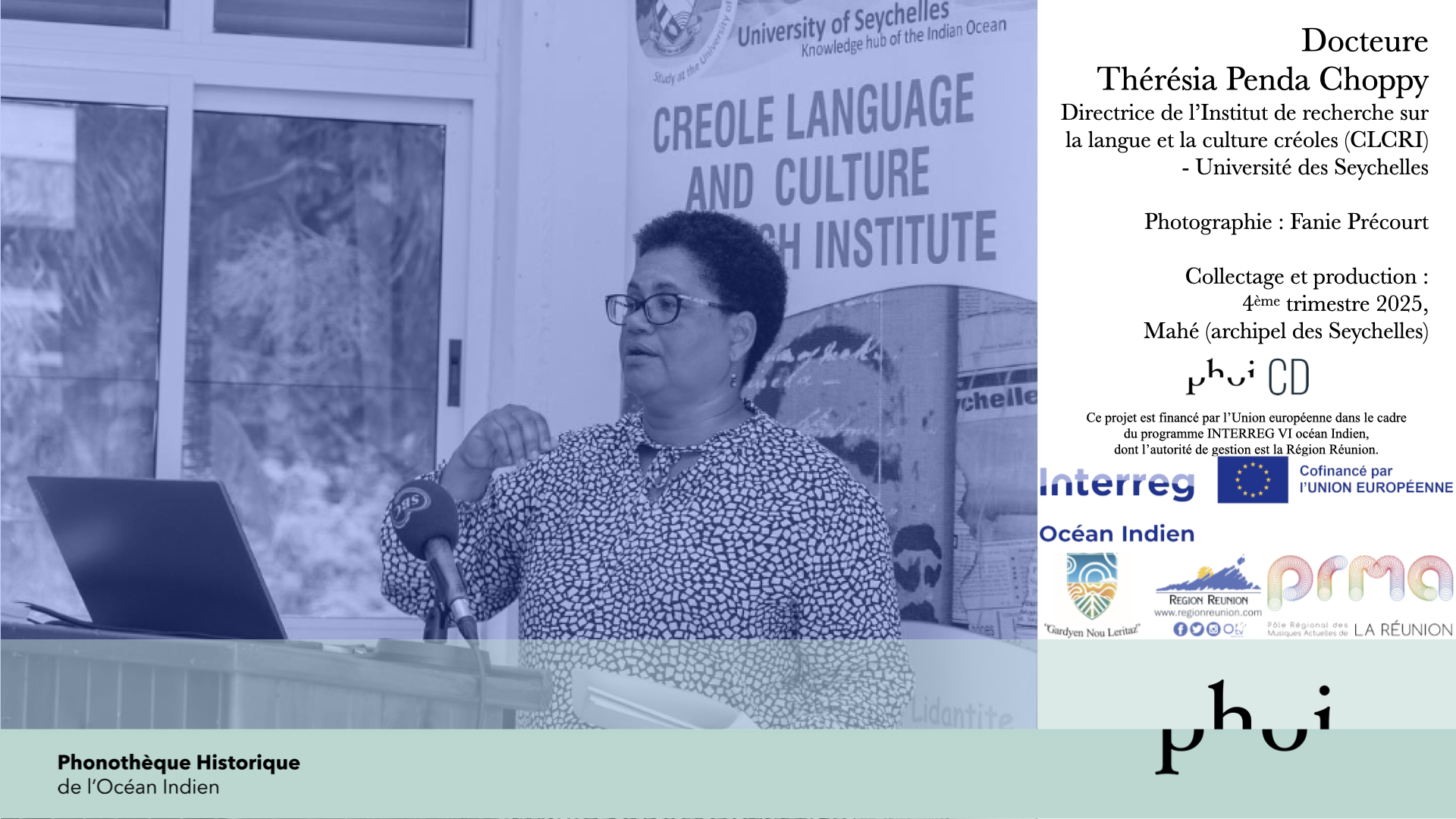
 In this episode, Thérésia Penda Choppy, born in 1971, talks about her career and how she became Director of the Creole Language and Culture Research Institute at the University of Seychelles. During her seventeen years at the Creole Institute, one of her key projects was compiling the songs of Patrick Victor, which led to the publication of the book Griyo lepep (En Koleksyon Sanson Seychelles, ed. Okap / Lenstiti Kreol, Festival Kreol Sesel Edition, 2007). This research prompted her to explore the musician's writings and lyrics more broadly, as these cover topics such as the history of the Seychelles, family planning, religious beliefs, traditional culture (moutya, sega), as well as the founding figures of Seychellois heritage. She highlights the richness of these cultural expressions, while also emphasising the fragility of certain forms, such as tsinge and sokwe, that are now on the brink of extinction, and whose last living practitioners have all but vanished. However, she does note some promising exceptions, such as the group 'Masézarine', which continues to pass down customs such as the madilo (stick dance) within the family. While many of today's generation gravitate towards modern music, some performers are creatively reinterpreting traditional repertoires. She mentions Jean-Marc Volcy, for example, who has covered tracks by Ton Pa (Jacob Marie), as well as Elijah and Jahrimba, whose work highlights Creole expressions. Her goal is clear: to inspire younger generations to draw on these traditional sources and keep them alive through contemporary creation. She believes that the future of Seychellois culture hinges on productive dialogue between tradition and modernity.
Fanie Précourt
