
publié par
Fanie Précourt
28 août 2026
This project is part of ‘Indian Ocean Historical Sound Archive: collecting, safeguarding and sharing musical heritage’. It is co-financed by the Interreg VI Indian Ocean 2021-2027 programme, the French Embassy in the Seychelles, the Regional Council of Reunion, the Directorate of Cultural Affairs, and the Departmental Council of Reunion. It follows on from organological studies conducted in Mayotte in 2022 and Reunion in 2023. Building on this work, the PHOI team carried out a collection mission in the Seychelles during October and November 2025.
These accounts, gathered mainly from musicians and instrument makers, aim to celebrate Seychellois musical practices as well as raise awareness of them, ensuring their transmission and longevity for future generations. They offer the general public a chance to rediscover — or indeed discover — traditions, both past and present, as well as the instruments that enrich the region’s varied and diverse identity.
In these podcast episodes, the musicians also share insights into their professional journeys and the day-to-day realities of their work. They provide an overview of cultural life across the Seychelles, touching on ongoing dynamics as well as the difficulties and challenges they face. These testimonies thus shed valuable light on the current state of the music sector in the Seychelles.
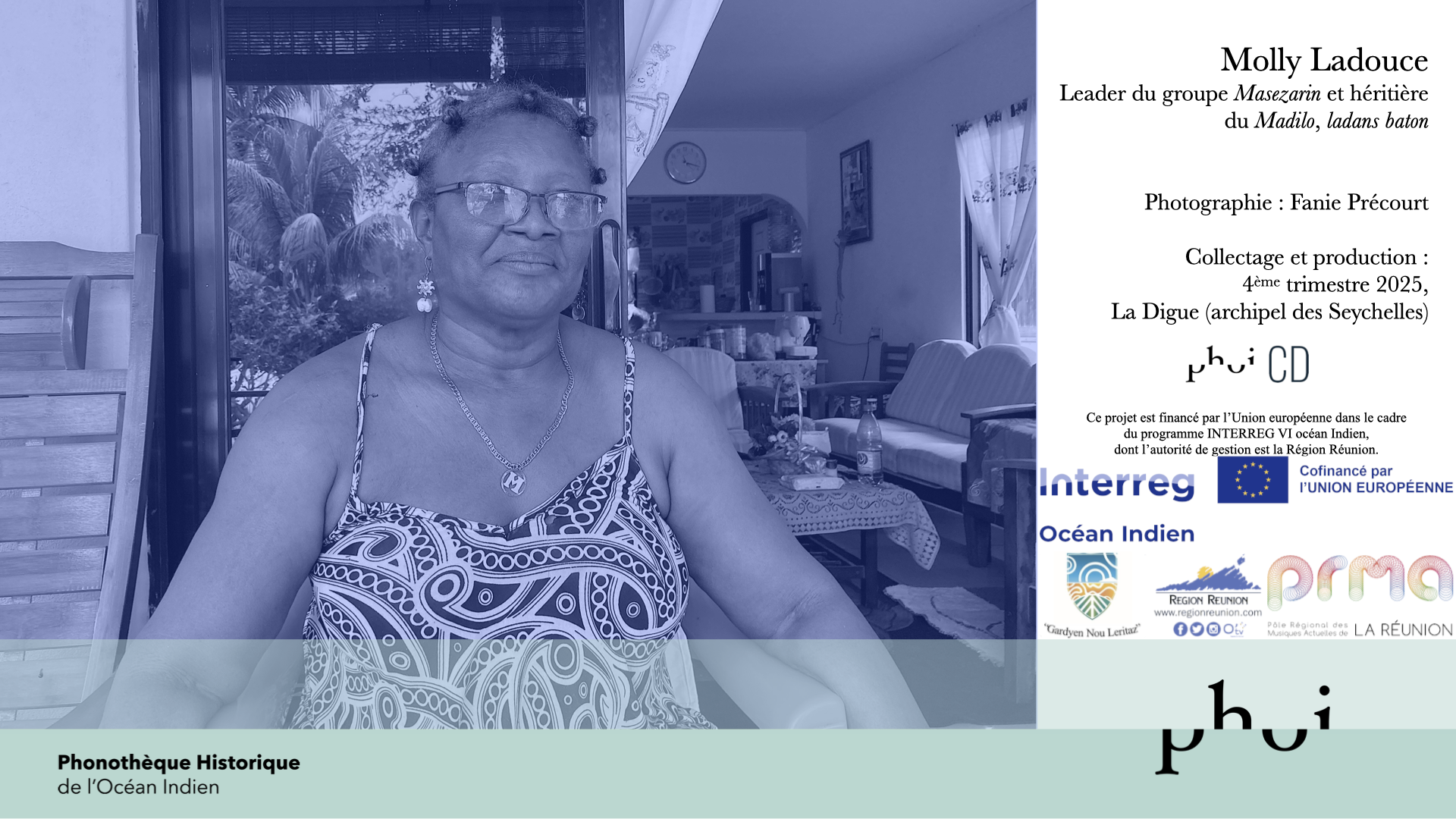
 Ethnographie des musiciens - Interview de Molly Ladouce - La Digue, 11/25.
 In this episode, Molly Ladouce, (born 1962) reflects on her journey with the family group 'Masézarine', founded on La Digue and active since 1977. She explains that the group truly took shape during a festival held on Praslin. Her love of music stems from her mother, who would strike the triyang while teaching her family the madilo stick dance. She had learnt this dance and song from her own father, who had seen them performed on Malagasy boats. The madilo was not well known in the Seychelles at the time. Presenting it at the Praslin festival earned Masézarine first prize, encouraging the group to introduce the practice throughout the country. In addition to madilo, Masézarine performs a wide repertoire of traditional dances and music including moutya, tsinge, circle dances, and romans. However, Molly points out that mastering dance, singing and instrument playing all at once is no easy task, and these skills were not passed down to them by their grandfather. She also expresses a degree of bitterness, saying that her repertoire is regularly copied without permission, especially on Mahé. Despite having taken steps to register madilo in her group’s name, she has realised that some performers have appropriated this creative work without giving due credit. She is concerned about her rights being infringed, and would welcome the opportunity to open a dialogue with any groups wishing to promote the repertoire she has reintroduced into Seychellois culture. Lastly, she mentions the financial challenges encountered by performers on La Digue, citing constant negotiations with hotels, reduced performance fees, and the difficulty of collecting royalties. This state of affairs makes life particularly precarious for performers from the island, in spite of their significant contribution to the country’s cultural heritage.
Fanie Précourt
