
publié par
Fanie Précourt
11 août 2026
This project is part of ‘Indian Ocean Historical Sound Archive: collecting, safeguarding and sharing musical heritage’. It is co-financed by the Interreg VI Indian Ocean 2021-2027 programme, the French Embassy in the Seychelles, the Regional Council of Reunion, the Directorate of Cultural Affairs, and the Departmental Council of Reunion. It follows on from organological studies conducted in Mayotte in 2022 and Reunion in 2023. Building on this work, the PHOI team carried out a collection mission in the Seychelles during October and November 2025.
These accounts, gathered mainly from musicians and instrument makers, aim to celebrate Seychellois musical practices as well as raise awareness of them, ensuring their transmission and longevity for future generations. They offer the general public a chance to rediscover — or indeed discover — traditions, both past and present, as well as the instruments that enrich the region’s varied and diverse identity.
In these podcast episodes, the musicians also share insights into their professional journeys and the day-to-day realities of their work. They provide an overview of cultural life across the Seychelles, touching on ongoing dynamics as well as the difficulties and challenges they face. These testimonies thus shed valuable light on the current state of the music sector in the Seychelles.
 Ethnographie des musiciens - Interview de Nac Joely - Mahé, 10/25.
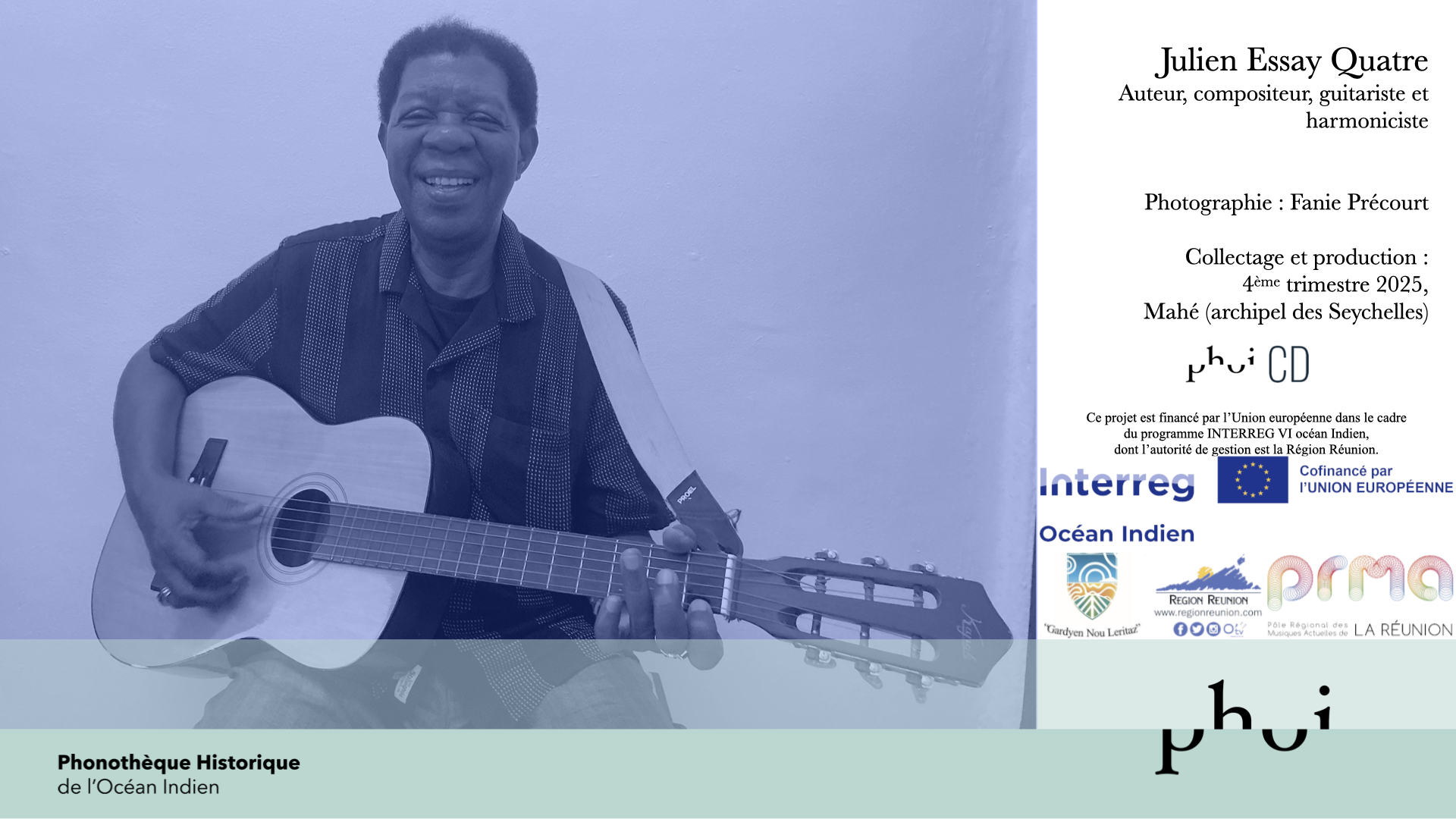
 In this episode, Julien Essay Quatre (born 1955), reflects on an artistic journey shaped by tradition and openness to the wider world. Starting out in 1992 as a kanmtole singer and guitarist, he gradually broadened his repertoire to include international songs. His first recording session, alongside David Philoé at Radyo Sesel, was a defining experience that marked the true beginning of his musical career, which he soon pursued as a solo artist. His debut album featured the track Pas dormi pays, which brought him to the attention of the general public. After this success, he began touring widely, giving concerts and performing at new venues. To Julien, the guitar is an instrument of endless possibility, offering constant scope to learn and grow. He vividly recalls crowds tapping out the rhythm on tables and plates, accompanying his vals or mazoks with spoons, while dancers brought the floor to life. He also remembers performing a Seychelles sega at a hotel in Nairobi, Kenya, where the African audience danced with even greater enthusiasm than the Seychellois! Julien Essay Quatre highlights the depth and diversity of the traditional Seychellois repertoire, while acknowledging the contribution of modern music, which allows traditions to evolve and encourages cultural blending. He cites moutya as an example of how the genre has changed over time, explaining that his own songs feature more elaborate lyrics than those once sung with the bonm, following in the footsteps of performers such as Ton Pa. Nonetheless, he regrets that the younger generation is moving away from this music and their roots more broadly. He believes they should reconnect with this heritage – particularly by engaging with their elders – to gain a better understanding of the past before embracing new tools. He concludes that the Ministry of Culture has a key role to play in supporting this transmission and rekindling interest in traditional music.
Fanie Précourt
