
publié par
Fanie Précourt
4 août 2026
This project is part of ‘Indian Ocean Historical Sound Archive: collecting, safeguarding and sharing musical heritage’. It is co-financed by the Interreg VI Indian Ocean 2021-2027 programme, the French Embassy in the Seychelles, the Regional Council of Reunion, the Directorate of Cultural Affairs, and the Departmental Council of Reunion. It follows on from organological studies conducted in Mayotte in 2022 and Reunion in 2023. Building on this work, the PHOI team carried out a collection mission in the Seychelles during October and November 2025.
These accounts, gathered mainly from musicians and instrument makers, aim to celebrate Seychellois musical practices as well as raise awareness of them, ensuring their transmission and longevity for future generations. They offer the general public a chance to rediscover — or indeed discover — traditions, both past and present, as well as the instruments that enrich the region’s varied and diverse identity.
In these podcast episodes, the musicians also share insights into their professional journeys and the day-to-day realities of their work. They provide an overview of cultural life across the Seychelles, touching on ongoing dynamics as well as the difficulties and challenges they face. These testimonies thus shed valuable light on the current state of the music sector in the Seychelles.
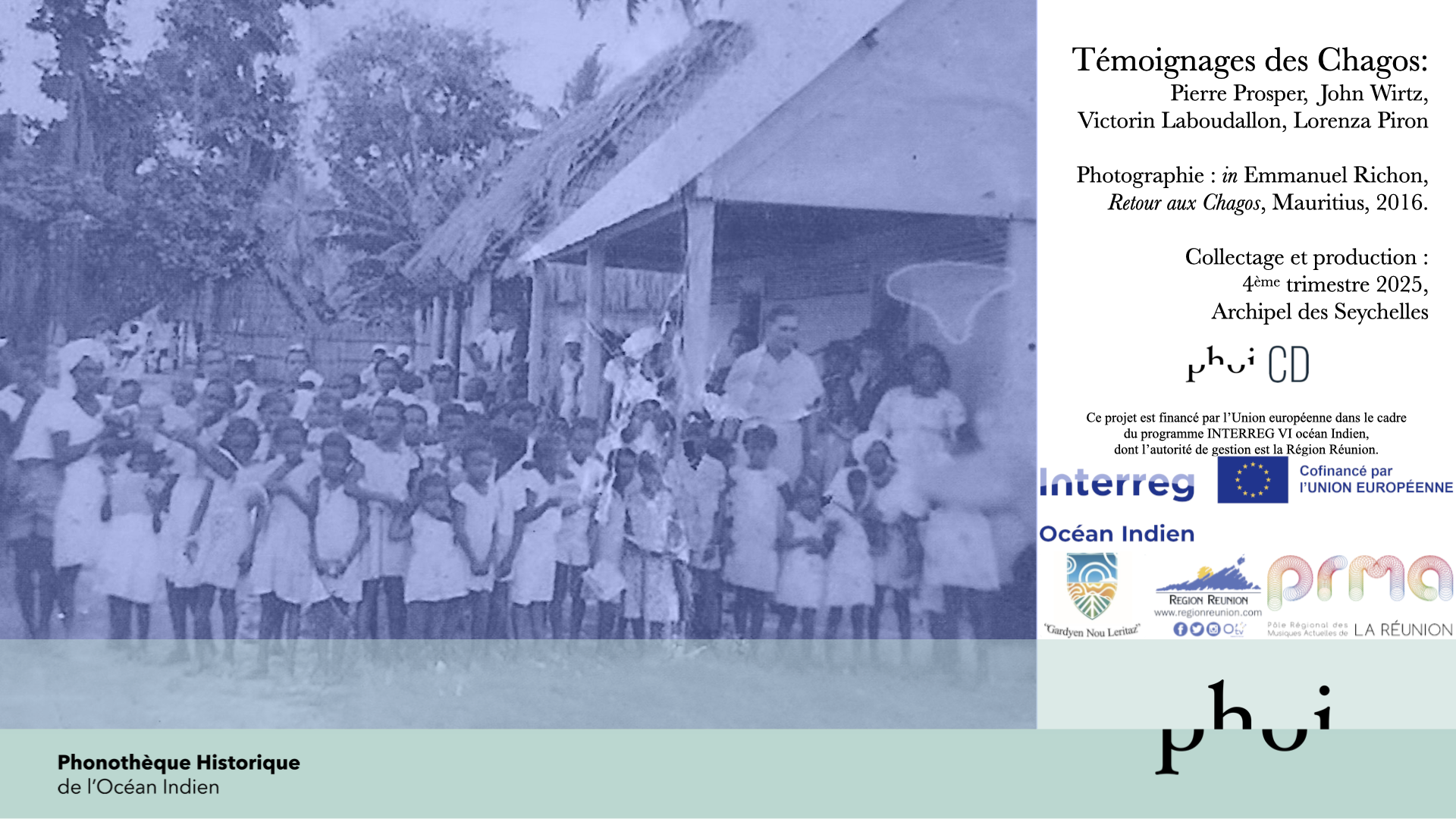
 Ethnographie des musiciens - Interview de Pierre Prosper, Lorenza Piron, Victorin Laboudallon et John Wirtz - Mahé et Praslin, 10/25.
 In this final episode, we hear once again from Pierre Prosper and Lorenza Piron, both born in the Chagos Archipelago, as well as from Victorin Laboudallon and John Wirtz, two musicians who spent time on these islands before they started becoming inaccessible in the 1970s. Pierre Prosper was only one year old when he was subjected to the mass, forced deportation of the Chagossians. Although he barely knew his native island, he remains deeply affected by this crime against humanity. He is now the spokesperson for the Chagossian community in the Seychelles. As such, he seeks to defend their rights, bringing together those living in exile, and campaigning for the return of the archipelago to its people. Pierre tells us that the Chagos were first populated in 1776 with the establishment of a colony, when slaves were brought from Africa and Madagascar to toil in the coconut groves. Their descendants lived peacefully on the islands up until the 1960s, developing their own culture, language and musical traditions. Following the Second World War, the islands were administered by the Chagos Agalega Company, and many Seychellois settled there, gradually mixing their culture with that of the existing population, giving rise to a distinct Creole identity. John Wirtz recalls having had the opportunity between 1967 and 1968 to travel to Diego Garcia, the main island of the archipelago, which also includes Salomon and Peros Banhos, although he was unable to visit the latter two atolls. He mainly worked fishing and harvesting coconuts. Music held an important place in everyday life, and musicians included a violinist and a guitarist. John himself managed to buy a guitar when a yacht stopped by. Tanbour moutya, crates, and even oil drums were used to provide percussion and replace drum sets. Kanmtole was also performed. Small frame drums were made from the skin of the thornback ray (Raja clavata). And – as John jokingly points out – mosquitoes were probably the most numerous inhabitants of the islands. He was the first musician to return to the Seychelles and compose songs dedicated to the Chagos, paving the way for other songwriters such as Raymond Barat and Victorin Laboudallon, who travelled to Diego Garcia twice, in 1967 and again in 1980. Pierre Prosper has spent many years working with the Mauritian government to ensure the archipelago is ceded back to the Chagossians, despite significant political pressure from Britain and the United States. This struggle belongs to a wider pattern of tragic destinies endured by the exiles, such as that of Lorenza Piron. A native of Diego Garcia, married to a Seychellois man, and mother of two children born in the Chagos, she was expelled from her home island. Having been forcibly uprooted from her birthplace and abandoned by her husband, she never truly found her place in Seychellois society, illustrating the deep-rooted sense of displacement typically experienced by Chagossians.
Fanie Précourt
