
publié par
Fanie Précourt
31 juillet 2026
This project is part of ‘Indian Ocean Historical Sound Archive: collecting, safeguarding and sharing musical heritage’. It is co-financed by the Interreg VI Indian Ocean 2021-2027 programme, the French Embassy in the Seychelles, the Regional Council of Reunion, the Directorate of Cultural Affairs, and the Departmental Council of Reunion. It follows on from organological studies conducted in Mayotte in 2022 and Reunion in 2023. Building on this work, the PHOI team carried out a collection mission in the Seychelles during October and November 2025.
These accounts, gathered mainly from musicians and instrument makers, aim to celebrate Seychellois musical practices as well as raise awareness of them, ensuring their transmission and longevity for future generations. They offer the general public a chance to rediscover — or indeed discover — traditions, both past and present, as well as the instruments that enrich the region’s varied and diverse identity.
In these podcast episodes, the musicians also share insights into their professional journeys and the day-to-day realities of their work. They provide an overview of cultural life across the Seychelles, touching on ongoing dynamics as well as the difficulties and challenges they face. These testimonies thus shed valuable light on the current state of the music sector in the Seychelles.
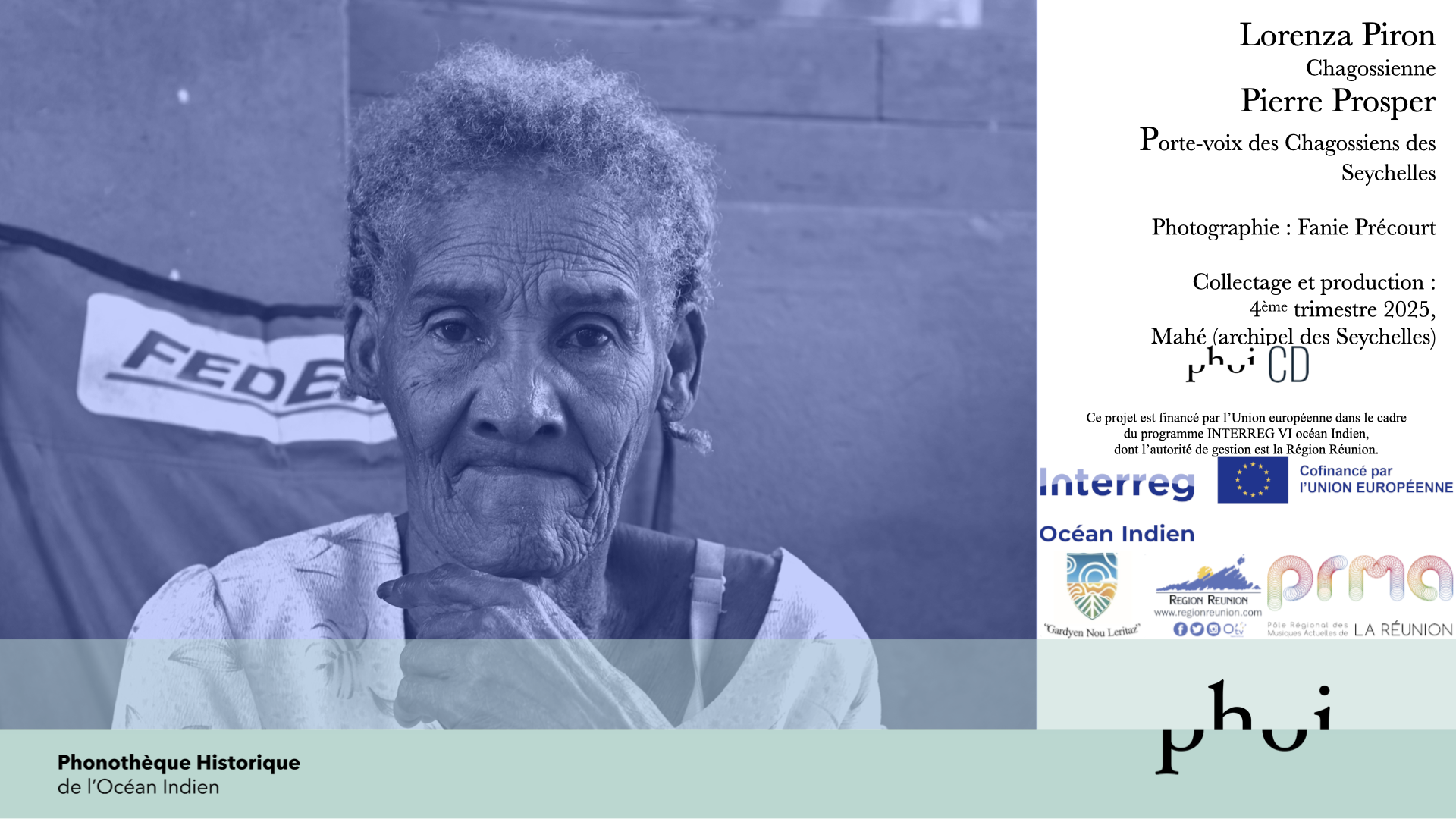
 Ethnographie des musiciens - Interview de Lorenza Piron - Mahé, 10/25.
 In this episode, Lorenza Piron, born in the Chagos Archipelago in the 1940s, shares a moving account of her life since she and her fellow Chagossians were forcibly displaced to the Seychelles in 1970. The daughter of a mother from Peros Banhos Atoll, Lorenza grew up on Diego Garcia, where she laboured on the coconut plantation and took part in hunting expeditions in the woods. Mornings were devoted to work, afternoons to fishing, while weekends revolved around community celebrations and prayer. The sounds of sega set the pace for Saturdays, danced to the beat of frame drums whose membranes were fashioned from donkey, horse, or ray skin. If there was no triangle, people improvised by striking glass bottles or clapping spoons together. Female dancers would lift their skirts to reveal their petticoats to the male dancers opposite who were ‘blocking the way’. Lorenza particularly remembers her cousin Charlésia Alexis, a highly regarded sega singer. Over time, however, the lyrics to the songs have faded from her memory. Lorenza raised five children with her Seychellois husband, but lost her Chagossian family during the mass removal from their homeland. Some of her relatives, including her sister and her cousin Charlésia, were sent to Mauritius, and she has not seen them for more than fifty years. When she arrived penniless in the Seychelles, she faced hardship and slept in the forest as there was no institutional support. Now elderly and in poor health, she lives on a meagre pension that barely stretches far enough to provide for her and her cat, her sole companion. She still harbours a fierce anger towards the United States, whose establishment of a military base on Diego Garcia triggered the eviction of an entire people, forced to leave behind their homes, belongings, and animals – and watch them being burned. Consumed by longing, Lorenza clings to her last remaining wish – to set foot on her native land again one day. ‘Give me back my island’, she says – a plea for both remembrance and justice.
Fanie Précourt
