
published by
Fanie Précourt
22 mai 2026
This project is part of ‘Indian Ocean Historical Sound Archive: collecting, safeguarding and sharing musical heritage’. It is co-financed by the Interreg VI Indian Ocean 2021-2027 programme, the French Embassy in the Seychelles, the Regional Council of Reunion, the Directorate of Cultural Affairs, and the Departmental Council of Reunion. It follows on from organological studies conducted in Mayotte in 2022 and Reunion in 2023. Building on this work, the PHOI team carried out a collection mission in the Seychelles during October and November 2025.
These accounts, gathered mainly from musicians and instrument makers, aim to celebrate Seychellois musical practices as well as raise awareness of them, ensuring their transmission and longevity for future generations. They offer the general public a chance to rediscover — or indeed discover — traditions, both past and present, as well as the instruments that enrich the region’s varied and diverse identity.
In these podcast episodes, the musicians also share insights into their professional journeys and the day-to-day realities of their work. They provide an overview of cultural life across the Seychelles, touching on ongoing dynamics as well as the difficulties and challenges they face. These testimonies thus shed valuable light on the current state of the music sector in the Seychelles.
 Ethnographie des musiciens - Interview de Jeff Bibi - La Digue, 11/25.
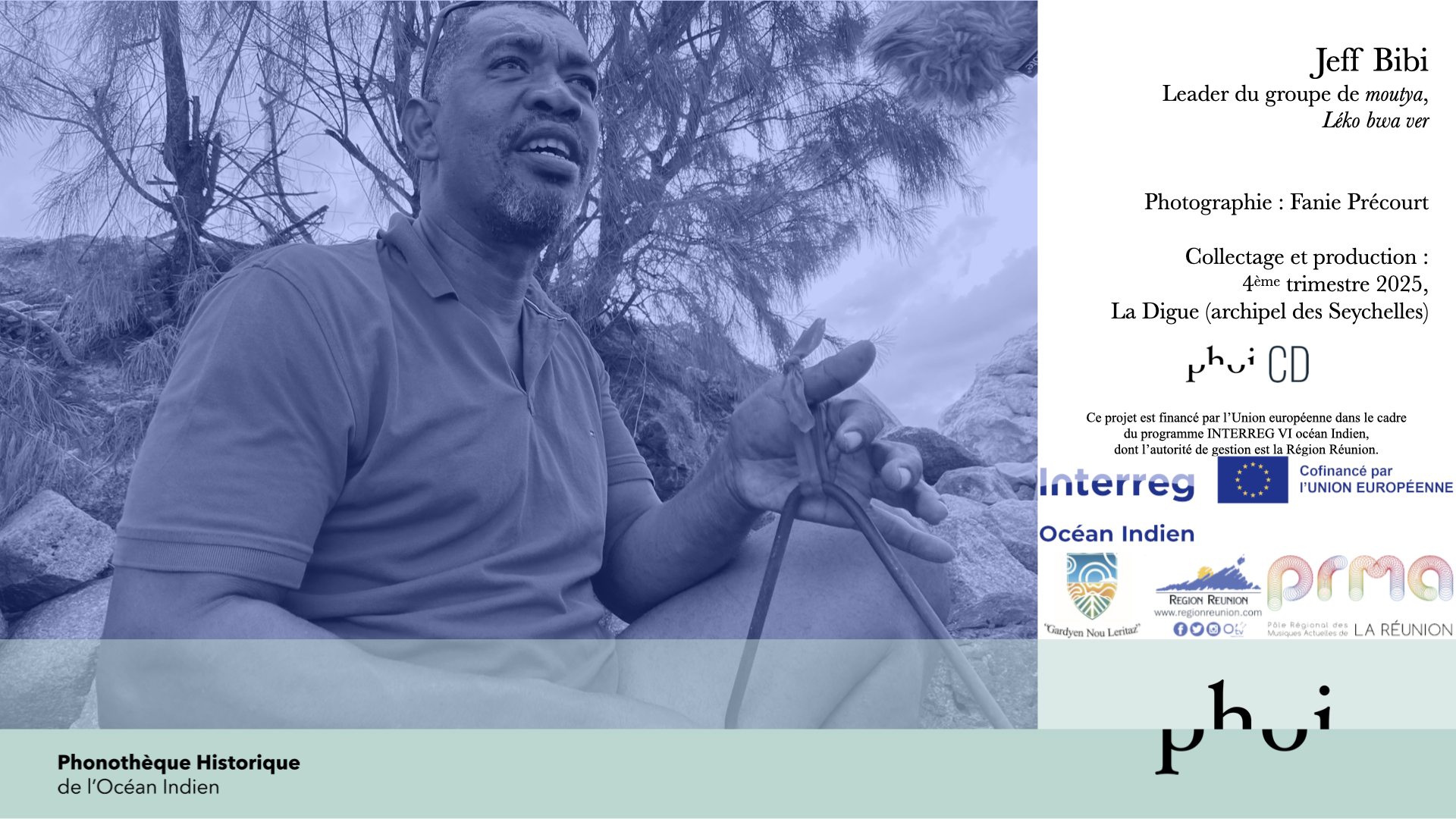
 In this episode, Jeff Bibi, born on La Digue in 1979, talks about how he has been making music since his formative years. He got his start with the group ‘Masézarine’, before founding his own outfit, ‘Léko Bwaver’, named in tribute to a former musician known as Bwaver. The group allows him to keep a traditional musical heritage alive. In terms of instruments, Léko Bwaver features the ravann (a frame drum similar to the tanbour moutya), djembe, and triyang. Jeff points out that traditional Seychellois instruments are now on the verge of disappearing. Thus, within the group – specialising in traditional moutya and sega otantik, a faster-paced style than classic sega – the tanbour moutya has gradually given way to the Mauritian ravann and the djembe. The triyang is the group’s last remaining locally made instrument, fashioned from a heated metal rod and shaped by hand. Jeff regrets that they are no longer booked to perform in hotels, a trend which is causing a steady decline in the number of active musicians.
Fanie Précourt
