
published by
Fanie Précourt
15 mai 2026
This project is part of ‘Indian Ocean Historical Sound Archive: collecting, safeguarding and sharing musical heritage’. It is co-financed by the Interreg VI Indian Ocean 2021-2027 programme, the French Embassy in the Seychelles, the Regional Council of Reunion, the Directorate of Cultural Affairs, and the Departmental Council of Reunion. It follows on from organological studies conducted in Mayotte in 2022 and Reunion in 2023. Building on this work, the PHOI team carried out a collection mission in the Seychelles during October and November 2025.
These accounts, gathered mainly from musicians and instrument makers, aim to celebrate Seychellois musical practices as well as raise awareness of them, ensuring their transmission and longevity for future generations. They offer the general public a chance to rediscover — or indeed discover — traditions, both past and present, as well as the instruments that enrich the region’s varied and diverse identity.
In these podcast episodes, the musicians also share insights into their professional journeys and the day-to-day realities of their work. They provide an overview of cultural life across the Seychelles, touching on ongoing dynamics as well as the difficulties and challenges they face. These testimonies thus shed valuable light on the current state of the music sector in the Seychelles.
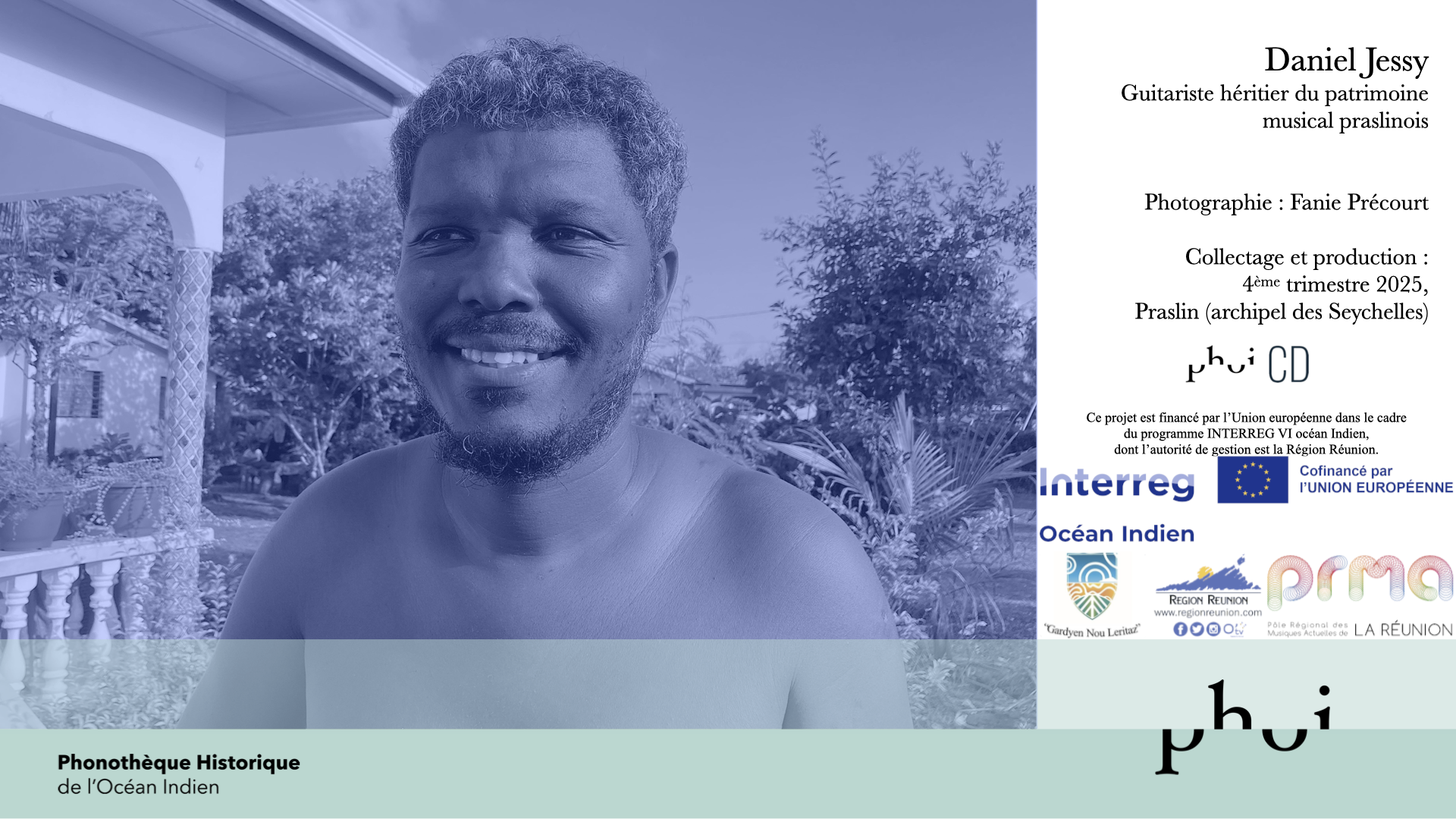
 Ethnographie des musiciens - Interview de Daniel Jessy - Praslin, 11/25.
 In this episode, Daniel Jessy, a professional bassist and guitarist from Praslin born in 1982, discusses a career that has largely been spent performing on the hotel circuit. He comes from a long line of musicians spanning three generations. Both his grandfather and father were folk fiddlers who provided the music for dances held at private homes. Daniel tells the story of his father, Charles Espérance, who taught himself to play using nothing more than a stick with a string attached. Seizing the opportunity whenever his father was away, he would practise the violin – a precious instrument kept at the head of his parents' bed. The day when Charles finally showed his father what he could do, the older man was moved to tears and invited him to play alongside him at the daily dances. After Daniel's grandfather hung up his bow, Charles continued his work, mainly performing at the islands’ hotels. Following in his father’s footsteps, Daniel learnt the guitar by ear, practising at night. He began his career at 26, teaming up with Charles and playing in various hotels. As Daniel sees it, traditional Seychelles music is currently struggling to thrive, overshadowed by the impact of world music. He believes that local musicians need to join forces to develop it, ensuring it receives recognition, and reaches a global audience.
Fanie Précourt
