
publié par
Fanie Précourt
12 mai 2026
This project is part of ‘Indian Ocean Historical Sound Archive: collecting, safeguarding and sharing musical heritage’. It is co-financed by the Interreg VI Indian Ocean 2021-2027 programme, the French Embassy in the Seychelles, the Regional Council of Reunion, the Directorate of Cultural Affairs, and the Departmental Council of Reunion. It follows on from organological studies conducted in Mayotte in 2022 and Reunion in 2023. Building on this work, the PHOI team carried out a collection mission in the Seychelles during October and November 2025.
These accounts, gathered mainly from musicians and instrument makers, aim to celebrate Seychellois musical practices as well as raise awareness of them, ensuring their transmission and longevity for future generations. They offer the general public a chance to rediscover — or indeed discover — traditions, both past and present, as well as the instruments that enrich the region’s varied and diverse identity.
In these podcast episodes, the musicians also share insights into their professional journeys and the day-to-day realities of their work. They provide an overview of cultural life across the Seychelles, touching on ongoing dynamics as well as the difficulties and challenges they face. These testimonies thus shed valuable light on the current state of the music sector in the Seychelles.
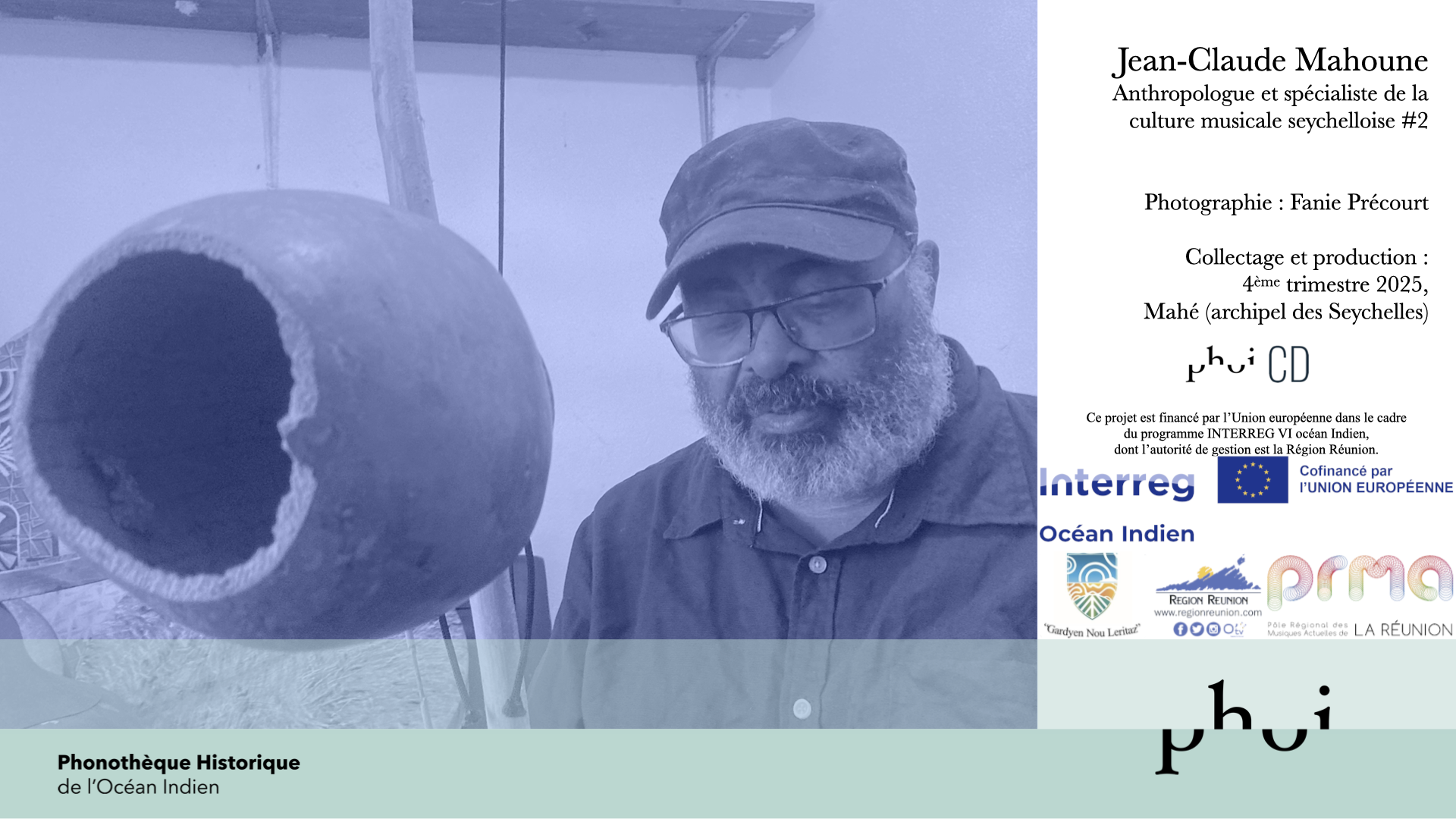
 Etude musicologique - Interview n°2 de Jean-Claude Mahoune - Mahé, 10/25.
 In this episode, Jean-Claude Pascal Mahoune, a former researcher at the Seychelles Ministry of Culture, offers insights from his studies into traditional Seychellois music - a genre shaped by Afro-Malagasy, European and Asian influences. He talks about tsinge, which was found in baka houses, and was performed and sung in dialect, most notably by the musician Ton Pa (Jacob Marie). Tsinge – part game, part dance – was marked by hand clapping. The lyrics, which were often misunderstood, reportedly reached the Seychelles with African soldiers who served in the British Army during the Second World War, and the local population then repeated the songs phonetically. In festive settings, songs like these — frequently fuelled by alcohol — helped overcome tiredness. These gatherings, sometimes misinterpreted, included communal rituals, such as slaughtering an ox to feed the wider community. Tsinge dances were accompanied by the bonm, although virtually any everyday object could be used to add rhythm. Interestingly, the bonm was ‘rediscovered’ in the Seychelles via Brazilian capoeira rather than through an unbroken local tradition. Mahoune also mentions sokwe, a masked dance unique to the Seychelles, which is usually performed without singing and takes its name from the Seychelles Creole word for 'to shake'. The dancers wore costumes made of banana leaves and moved to the rhythm of vocal interjections. Derogatorily nicknamed the 'monkey' or ‘baboon dance’, it often intimidated children. This dance, particularly its feast scene, marked the end of the theatrical part of festivities. Ton Pa joked that the most spectacular sokwe could be achieved by throwing a venomous centipede among the dancers! He was an inventive musician who also played the chordophone bonm, and helped develop the design of stick used with it. Jean-Claude Mahoune is committed to passing on this knowledge, and concludes the interview by voicing concern that the younger generation is unable to fully access their heritage due to a lack of institutional support.
Fanie Précourt
