
publié par
Fanie Précourt
24 avril 2026
This project is part of ‘Indian Ocean Historical Sound Archive: collecting, safeguarding and sharing musical heritage’. It is co-financed by the Interreg VI Indian Ocean 2021-2027 programme, the French Embassy in the Seychelles, the Regional Council of Reunion, the Directorate of Cultural Affairs, and the Departmental Council of Reunion. It follows on from organological studies conducted in Mayotte in 2022 and Reunion in 2023. Building on this work, the PHOI team carried out a collection mission in the Seychelles during October and November 2025.
These accounts, gathered mainly from musicians and instrument makers, aim to celebrate Seychellois musical practices as well as raise awareness of them, ensuring their transmission and longevity for future generations. They offer the general public a chance to rediscover — or indeed discover — traditions, both past and present, as well as the instruments that enrich the region’s varied and diverse identity.
In these podcast episodes, the musicians also share insights into their professional journeys and the day-to-day realities of their work. They provide an overview of cultural life across the Seychelles, touching on ongoing dynamics as well as the difficulties and challenges they face. These testimonies thus shed valuable light on the current state of the music sector in the Seychelles.
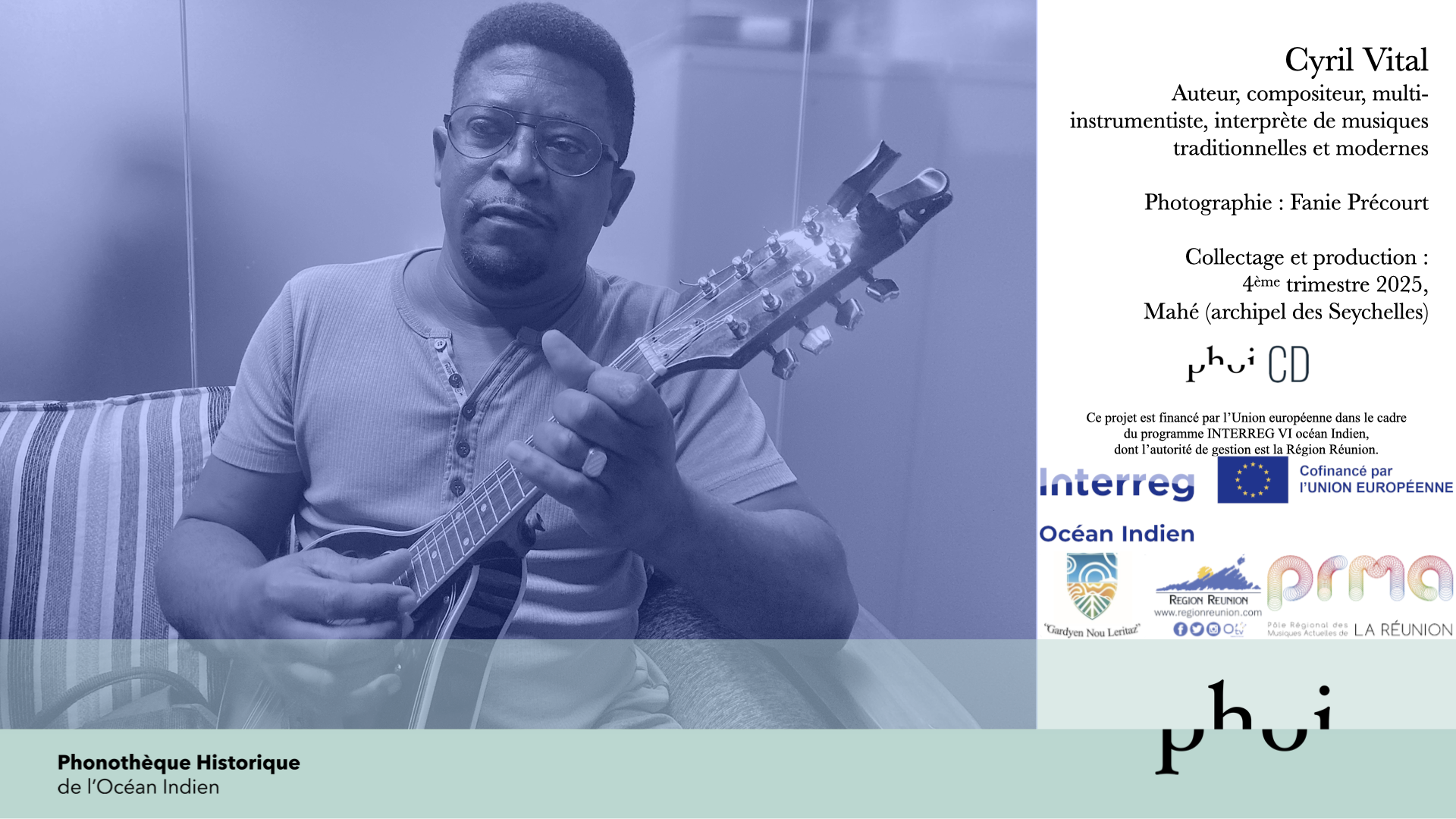
 Ethnographie des musiciens - Interview de Cyril Vital - Mahé, 11/25.
 In this episode, Cyril Vital talks about growing up immersed in music. Born in 1966 into a musical family of of simple means, he was raised to the sounds of the violin, banjo, guitar and accordion – instruments that provided an accompaniment for the dances he attended in his rural community. He taught himself by ear as a young child, playing along to the radio and practising on the adults' instruments once they had left for work. This upbringing had a deep impact on him, eventually leading him to pursue a career in music. Making a living this way is very difficult at present, and the profession itself is on the verge of dying out – mirroring the decline of traditional instruments such as the bonm, makalapo and zez. Successors are few and far between nowadays, as young people increasingly focus on the digital world and modern media, neither of which pass down local musical heritage, even though the Seychelles is a tourist destination. The sobering reality is that, although groups exist, they often lack opportunities to actually perform. As a result, musicians have little choice but to take on other jobs just to make ends meet. Despite everything, Cyril continues to pursue his passion, typically finding work as a session artist. Now older, he persists on this career path, yet remains reluctant to encourage the next generation to follow suit, being acutely aware of how hard it is to earn a living from music. By way of example, he has not received any royalties from the Seychelles Society of Authors and Composers for the past four years, due to the poor governance of cultural institutions. This situation starkly illustrates the challenges faced by those trying to preserve this musical heritage.
Fanie Précourt
