
publié par
Fanie Précourt
4 septembre 2026
This project is part of ‘Indian Ocean Historical Sound Archive: collecting, safeguarding and sharing musical heritage’. It is co-financed by the Interreg VI Indian Ocean 2021-2027 programme, the French Embassy in the Seychelles, the Regional Council of Reunion, the Directorate of Cultural Affairs, and the Departmental Council of Reunion. It follows on from organological studies conducted in Mayotte in 2022 and Reunion in 2023. Building on this work, the PHOI team carried out a collection mission in the Seychelles during October and November 2025.
These accounts, gathered mainly from musicians and instrument makers, aim to celebrate Seychellois musical practices as well as raise awareness of them, ensuring their transmission and longevity for future generations. They offer the general public a chance to rediscover — or indeed discover — traditions, both past and present, as well as the instruments that enrich the region’s varied and diverse identity.
In these podcast episodes, the musicians also share insights into their professional journeys and the day-to-day realities of their work. They provide an overview of cultural life across the Seychelles, touching on ongoing dynamics as well as the difficulties and challenges they face. These testimonies thus shed valuable light on the current state of the music sector in the Seychelles.
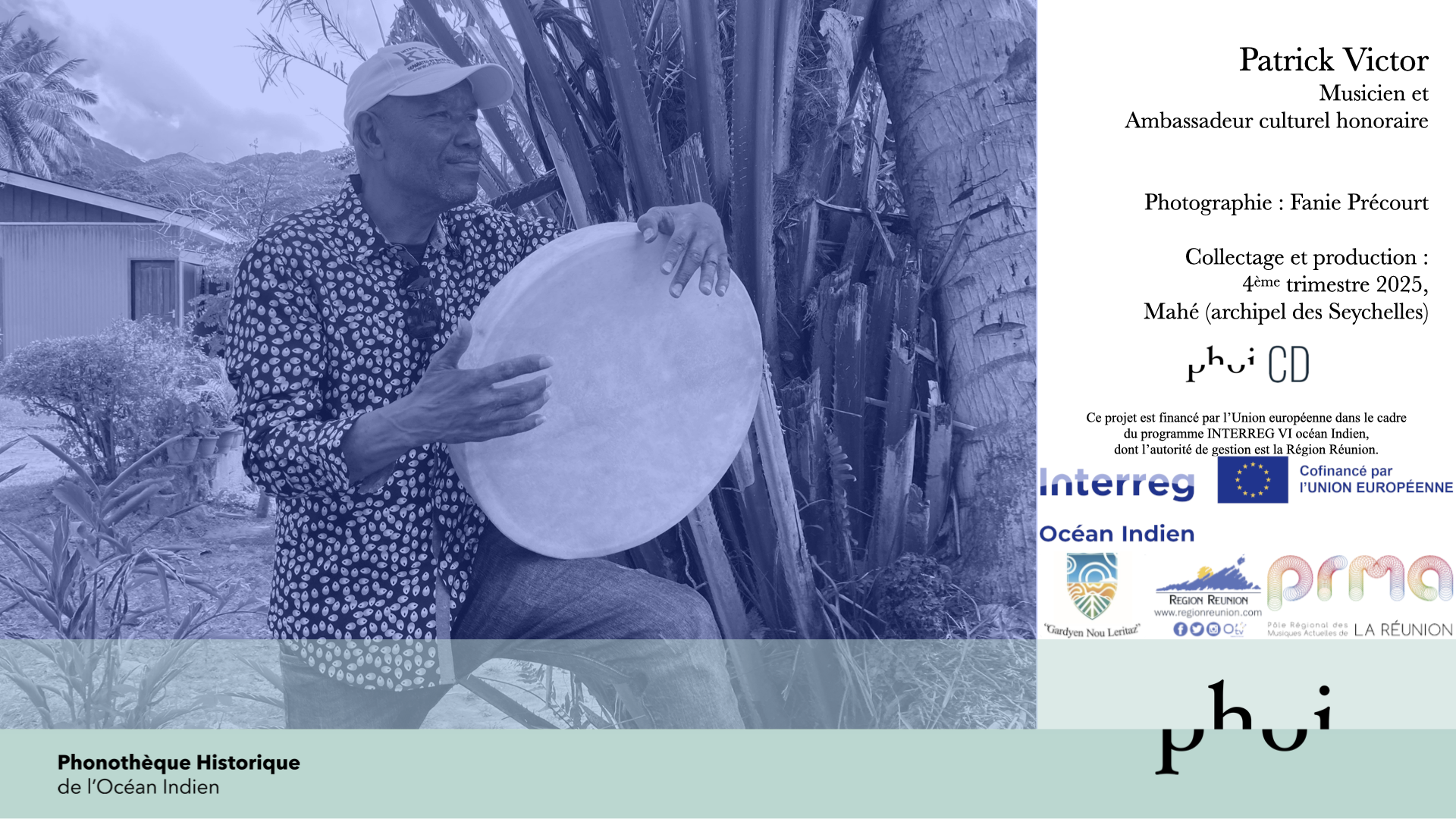
 Ethnographie des musiciens - Interview de Patrick Victor - Mahé, 11/25.
 In this episode, Patrick Victor (born 1952) staunchly defends the right to practise moutya, just as he defends the right to use Seychelles Creole, both of which he considers to be a treasured heritage passed down from his ancestors, but which were long suppressed under colonial rule. Born into a musical family – his mother was a singer, and his grandfather an accordionist – he describes himself as an artist with strong ties to ‘Creoleness’, seeking to reconnect with his forebears scattered across the Indian Ocean islands. He believes that the region has a shared cultural identity, pointing out that the Seychellois tanbour moutya echoes the Mauritian ravann, and that surnames such as Hoareau and Payet are found on La Digue and Mahé as well as Reunion Island. He recalls that there was a time when the use of drums for moutya or tsinge was prohibited by law, a ban that was only recently lifted. This repression had a profound effect on the passing down of skills and knowledge. Following independence, there was a major drive to revive local culture, with performers travelling through villages to encourage the practice of traditional dance, song, and instrumental music. This led to the emergence of numerous cultural groups and the creation of a national troupe. The message was clear: “Don't be afraid to speak Creole and embrace your traditional music and dances.” Patrick Victor goes on to discuss the making of traditional musical instruments. According to him, confiscating the drums resulted in a loss of expertise needed to make the hoops of Seychellois frame drums. He claims that the instruments of old possessed a certain ‘soul’ that modern-day drums struggle to replicate. At heart, he is determined to reclaim not only an artistic practice, but also an entire cultural and spiritual legacy.
Fanie Précourt
