
publié par
Fanie Précourt
9 juin 2026
This project is part of ‘Indian Ocean Historical Sound Archive: collecting, safeguarding and sharing musical heritage’. It is co-financed by the Interreg VI Indian Ocean 2021-2027 programme, the French Embassy in the Seychelles, the Regional Council of Reunion, the Directorate of Cultural Affairs, and the Departmental Council of Reunion. It follows on from organological studies conducted in Mayotte in 2022 and Reunion in 2023. Building on this work, the PHOI team carried out a collection mission in the Seychelles during October and November 2025.
These accounts, gathered mainly from musicians and instrument makers, aim to celebrate Seychellois musical practices as well as raise awareness of them, ensuring their transmission and longevity for future generations. They offer the general public a chance to rediscover — or indeed discover — traditions, both past and present, as well as the instruments that enrich the region’s varied and diverse identity.
In these podcast episodes, the musicians also share insights into their professional journeys and the day-to-day realities of their work. They provide an overview of cultural life across the Seychelles, touching on ongoing dynamics as well as the difficulties and challenges they face. These testimonies thus shed valuable light on the current state of the music sector in the Seychelles.
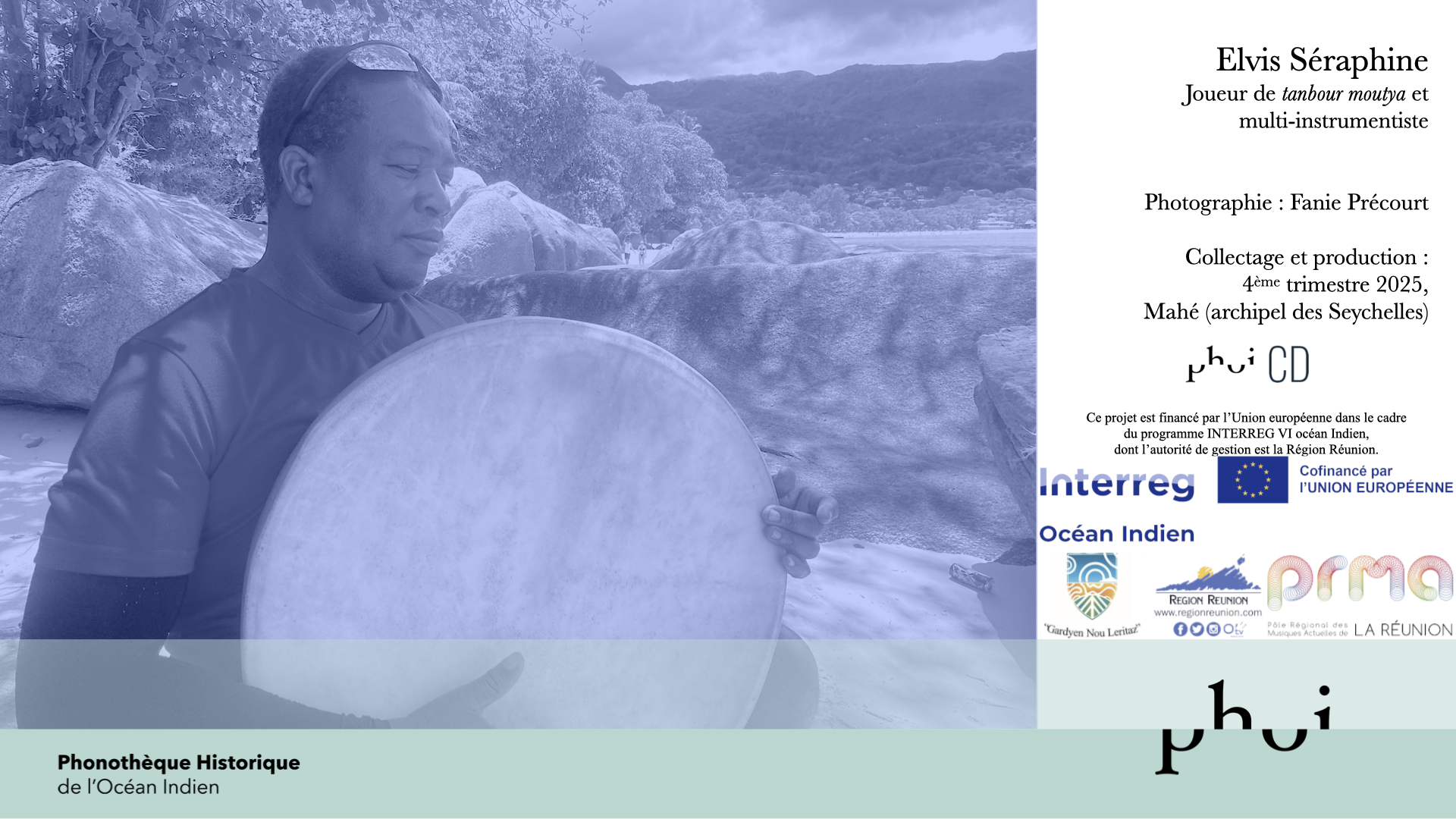
 Ethnographie des musiciens - Interview d`Elvis Séraphine - Mahé 11/25.
 In this episode, Elvis Séraphine, a tanbour moutya player born in 1975, shares the story of his introduction to traditional music. Music already ran in the family: his great-uncle was both a triyang player and a komandèr. From his earliest years, Elvis started attending Moutya Nights, cutting his teeth at these musical gatherings in the company of master drummers such as David Dindin. During such events – which took place on Sunday nights from 8pm until dawn – he began playing the drum alongside his friend Chanel Kilindo, in the hills above Bel Ombre. He was eventually encouraged to move from the uplands down to Beau Vallon, on the coast, in order to pursue his passion for music to the full. He recorded two albums, Dibwa Pointe and Madeleine (2006), with the latter spending eight months in the charts. He speaks poignantly of his deep connection to authentic tanbour moutya. Although he sometimes uses synthetic-skin drums for the sake of convenience when playing at hotels — avoiding the need to heat the skin to prevent it from slackening — he remains attached to traditional instruments. With nostalgia for a time when this culture thrived, he honours the legacy of his elders through his music and songwriting, striving to capture and pass on the spirit of moutya as it once was.
Fanie Précourt
