
publié par
Fanie Précourt
14 avril 2026
This project is part of ‘Indian Ocean Historical Sound Archive: collecting, safeguarding and sharing musical heritage’. It is co-financed by the Interreg VI Indian Ocean 2021-2027 programme, the French Embassy in the Seychelles, the Regional Council of Reunion, the Directorate of Cultural Affairs, and the Departmental Council of Reunion. It follows on from organological studies conducted in Mayotte in 2022 and Reunion in 2023. Building on this work, the PHOI team carried out a collection mission in the Seychelles during October and November 2025.
These accounts, gathered mainly from musicians and instrument makers, aim to celebrate Seychellois musical practices as well as raise awareness of them, ensuring their transmission and longevity for future generations. They offer the general public a chance to rediscover — or indeed discover — traditions, both past and present, as well as the instruments that enrich the region’s varied and diverse identity.
In these podcast episodes, the musicians also share insights into their professional journeys and the day-to-day realities of their work. They provide an overview of cultural life across the Seychelles, touching on ongoing dynamics as well as the difficulties and challenges they face. These testimonies thus shed valuable light on the current state of the music sector in the Seychelles.
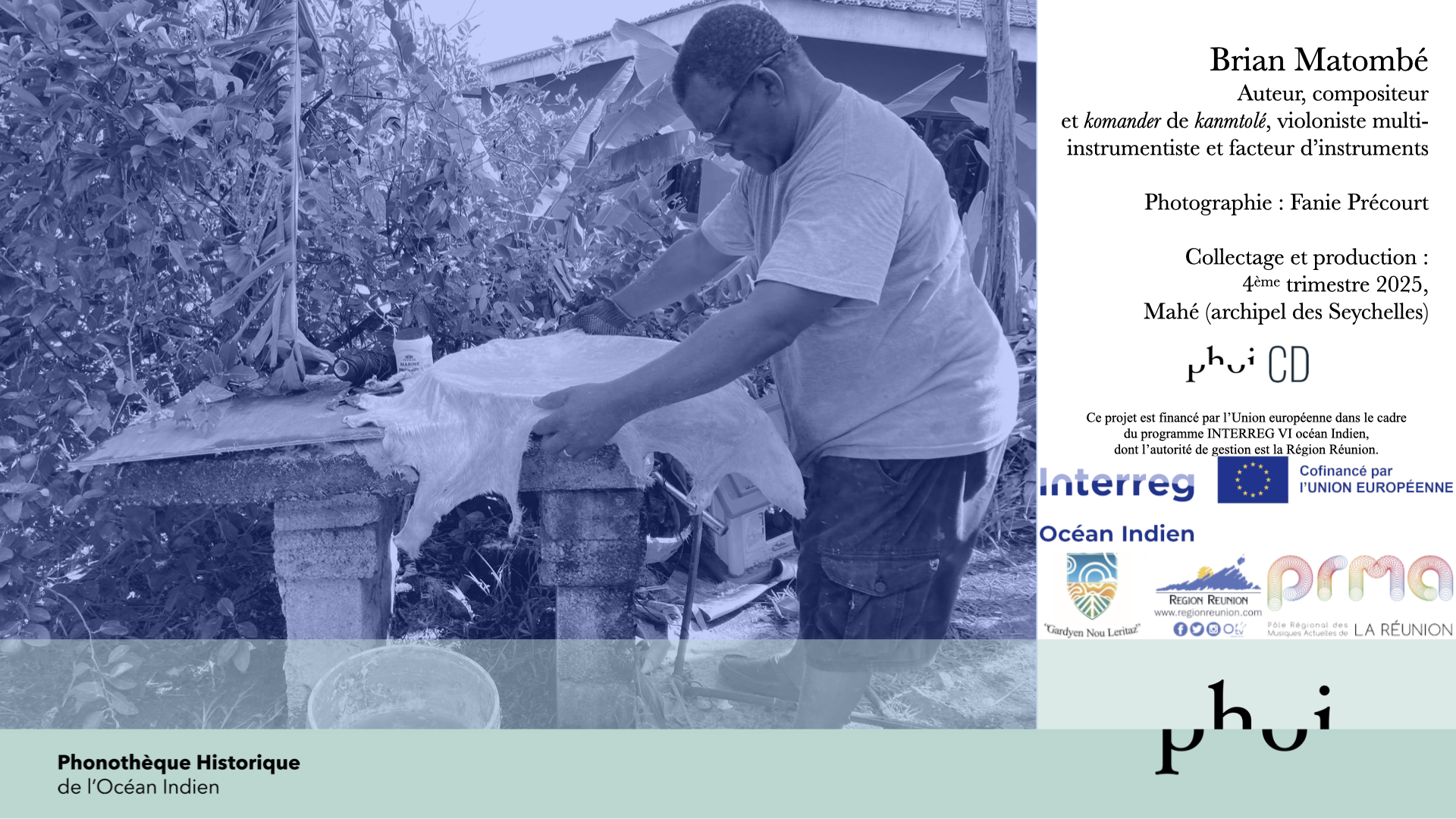
 Ethnographie des musiciens - Interview de Brian Matombé - Mahé, 11/25.
 In this episode, Brian Matombé, born in Anse Boileau in 1960 into a family of dancers – his mother sang traditional romans – describes how he got started in music. Driven by curiosity and determination, he would practise in secret on his stepfather’s instruments – violin and banjo – teaching himself entirely by ear. He began his career playing drums in his first group, before joining Latroup Nasyonal alongside Patrick Victor, where he continued as a drummer. He later mastered the tanbour moutya and tanbour sega. From a very young age, kanmtole dancers encouraged him to become a komandèr, a role that honed his vocal skills and led him to start singing. Brian explains that the kanmtole repertoire is split into two parts: free-form dances without a caller (vals, single and double kotis, polka, mazok, 4 pat), and structured set dances that follow a sequence (avant 2, avant 3, avant 4, min gos, min drwat, galop, finale, lanciers). Kanmtole used to be very popular across all districts, bolstered by various cultural troupes who organised regular exchange events and competitions. Nowadays, however, kanmtole groups have all but vanished, placing the future of this tradition in jeopardy. Brian appeals to the younger generation, as they are the only ones who can ensure the survival of these historic Seychellois dances and practices.
Fanie Précourt
