
publié par
Fanie Précourt
7 avril 2026
This project is part of ‘Indian Ocean Historical Sound Archive: collecting, safeguarding and sharing musical heritage’. It is co-financed by the Interreg VI Indian Ocean 2021-2027 programme, the French Embassy in the Seychelles, the Regional Council of Reunion, the Directorate of Cultural Affairs, and the Departmental Council of Reunion. It follows on from organological studies conducted in Mayotte in 2022 and Reunion in 2023. Building on this work, the PHOI team carried out a collection mission in the Seychelles during October and November 2025.
These accounts, gathered mainly from musicians and instrument makers, aim to celebrate Seychellois musical practices as well as raise awareness of them, ensuring their transmission and longevity for future generations. They offer the general public a chance to rediscover — or indeed discover — traditions, both past and present, as well as the instruments that enrich the region’s varied and diverse identity.
In these podcast episodes, the musicians also share insights into their professional journeys and the day-to-day realities of their work. They provide an overview of cultural life across the Seychelles, touching on ongoing dynamics as well as the difficulties and challenges they face. These testimonies thus shed valuable light on the current state of the music sector in the Seychelles.
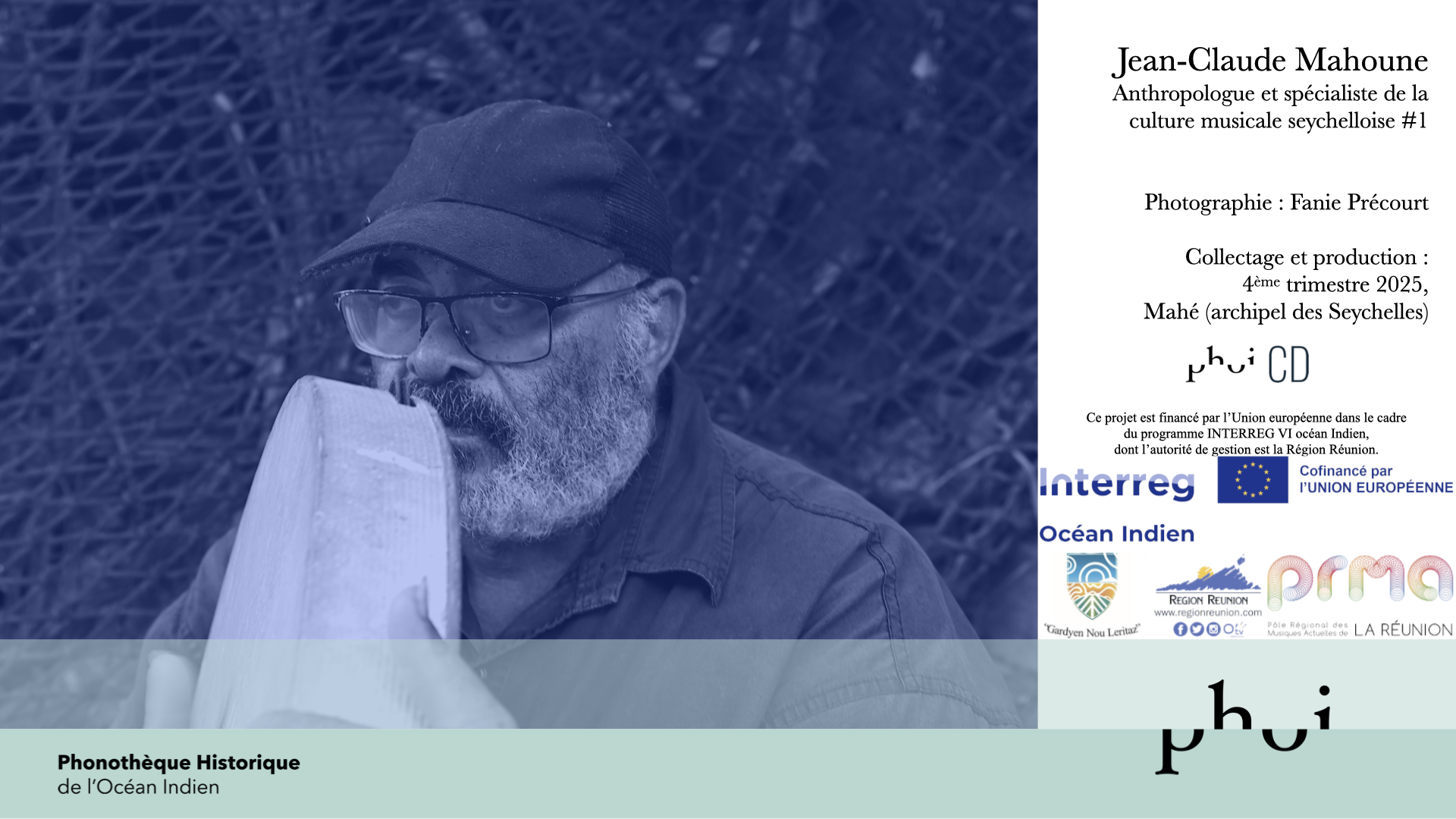
 Etude musicologique seychelloise - Interview de Jean-Claude Mahoune, Mahé, 08/25.
 In this episode, Jean-Claude Pascal Mahoune (born 1959), brings to bear his knowledge as a historian to talk about traditional Seychellois music. He begins with the sega, which is often considered to be uniquely Mauritian, yet also holds its own place across the archipelago. In the past, for example, sega tranble was very popular among the islanders of La Digue. Its fast-paced tempo caused dancers to tremble in a distinctive way. Just like the moutya, these segas were sung by rural communities and danced directly in the dust on the hard-packed earth. Moutya and sega tranble were associated with the working classes, whereas kanmtole was more favoured by the middle classes. In those days many dance halls featured sega alongside dances of European origin, and so this played a part in shaping modern sega as we now know it. Kanmtole specifically refers to a suite of dances (waltz, polka, mazurka, schottische, etc) introduced by French settlers from 1770 onwards, and which originated at the court of Louis XIV. Gradually, these repertoires were creolised and codified, giving rise to the vals, kotis, one-step, mazok, etc., while also incorporating caller-led country-style dances. These dances provided an opportunity for young people to meet – under their parents’ watchful eye. The musical ensemble typically comprised a violin, banjo, harmonica, and accordion, as well as a triangle played by the komander (dance caller). Song might be improvised based on everyday events, although some were introduced from Europe by soldiers. Kanmtole is arguably the Seychelles’ best-preserved musical tradition, as it was central to wedding celebrations and concerned the middle class. Unlike the moutya, this partner dance brought people together, encouraging physical closeness. Although it has become less common since the 1960s, gradually being eclipsed by modern sega, it is now an integral to the Seychellois cultural history.
Fanie Précourt
